
Introduction
Enterprise technology is entering a phase in which artificial intelligence must do more than generate text, analyze documents, or answer questions. Organizations increasingly need AI systems that can interpret their surroundings, make decisions based on real-world conditions, and interact with physical equipment. At the same time, enterprise networks must support growing numbers of connected devices, industrial sensors, autonomous machines, cloud applications, and AI workloads.
This is where physical AI and generative AI in enterprise networking become important. Although these technologies solve different problems, they can work together to support intelligent industrial environments, improve network operations, and reduce the amount of manual intervention required to maintain complex infrastructure.
Gtpxlzoi AI refers to AI systems that perceive, reason about, and act in the physical world. Examples include autonomous mobile robots, industrial robotic arms, intelligent vehicles, and machines that use cameras, sensors, and AI models to respond to changing conditions.
Generative AI, meanwhile, can interpret operational information, summarize network incidents, explain configuration problems, and help engineers develop network changes. When integrated with approved automation systems, it can also assist with troubleshooting and controlled configuration workflows.
The relationship matters because physical AI depends on reliable connectivity, while enterprise networking increasingly depends on software that can interpret large volumes of operational data. Neither technology removes the need for sound engineering, strong security controls, or human oversight.
This guide explains what physical AI is, how it differs from conventional AI, how generative AI is changing enterprise networking in 2026, and how organizations can connect these technologies without introducing unacceptable security, reliability, or cost risks.
1. What Is Physical AI? Understanding the Technology Behind Intelligent Machines
Physical AI describes AI systems designed to operate in physical environments rather than working exclusively with digital information. These systems combine AI models with sensors, computing hardware, control software, and actuators, enabling machines to perceive their surroundings, select actions, and respond to real-world conditions. IBM describes physical AI as AI that interacts with the physical world, including through sensors and control systems.
How Physical AI Works
Physical AI systems follow a continuous cycle of perception, reasoning, planning, and action. Cameras, lidar, microphones, temperature sensors, and other inputs provide information about the environment, while AI models interpret that information and help select an appropriate response.
1. Perception
Cameras, lidar, sensors, and equipment telemetry collect observations.
2. Reasoning and planning
AI models interpret conditions and determine a suitable next action.
3. Control and execution
Approved control software translates decisions into machine commands.
4. Feedback
New sensor readings confirm the result and inform subsequent decisions.
Consider a warehouse robot transporting components between storage racks. Its perception system detects obstacles, its planning system selects a route, and its control system commands the motors to follow that route.
If a forklift blocks the planned path, the robot may calculate an alternative route instead of waiting for a human operator. However, collision avoidance and emergency stopping should remain protected by independently validated safety mechanisms.
Physical AI vs. Generative AI vs. Traditional Automation
Although these technologies are related, they cannot be interchanged. Understanding their differences helps organizations choose the correct architecture for each workload.
| Technology | Primary Function | Enterprise Example |
|---|---|---|
| Traditional Automation | Executes predefined rules and workflows | A switch applies a configured access-control policy. |
| Generative AI | Produces or interprets content, including text and code | An assistant explains a network outage. |
| Physical AI | Perceives and acts in the physical world | A mobile robot navigates a factory floor. |
| Agentic AI | Plans and executes multistep tasks within assigned permissions | An operations agent investigates a connectivity incident. |
| AI-Assisted Networking | Uses AI to analyze, predict, or help manage network behavior | A network platform identifies abnormal traffic patterns. |
A single solution may combine several of these approaches. For example, a physical AI robot can use a vision model for perception, a planning model for navigation, and conventional control software for precise movement.
Generative AI can also serve as an interface through which engineers describe desired outcomes in natural language. The generated plan must still pass through validated tools and authorization checks before any configuration or physical action occurs.
Where Physical AI Is Being Used
Manufacturing is a natural starting point because industrial environments already contain sensors, programmable logic controllers, robotic arms, and automated production equipment. Physical AI can help robots handle variable objects, identify product defects, and adjust workflows when conditions change.
Warehousing and logistics offer additional opportunities. Autonomous mobile robots can move inventory, coordinate with warehouse management systems, and respond to changing routes or workloads.
The underlying technology also supports inspection robots, autonomous vehicles, agricultural machines, and certain healthcare applications. Deployment requirements differ considerably across these industries, particularly where human safety, environmental uncertainty, and regulatory obligations are involved.
2. How Generative AI Is Transforming Enterprise Networking in 2026
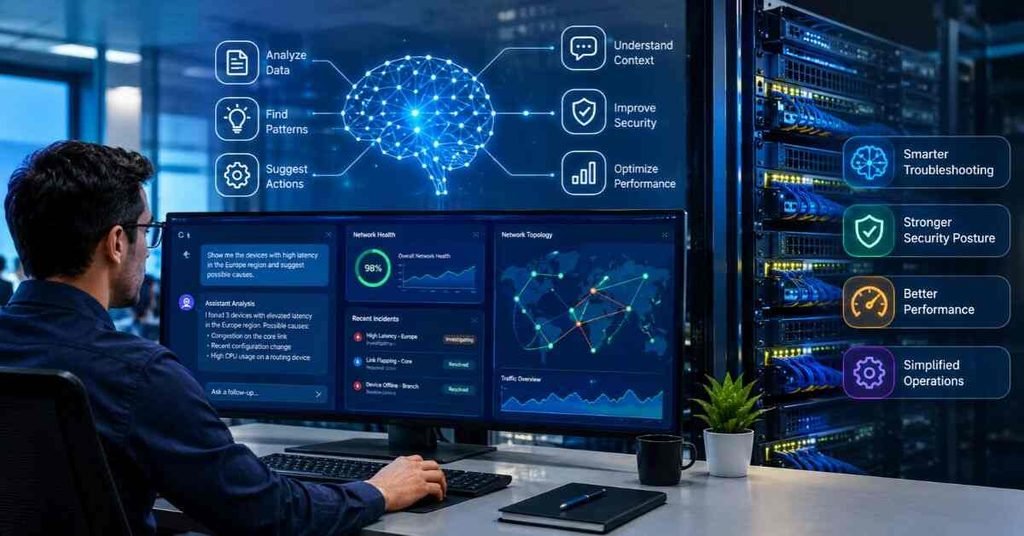
Enterprise networks have traditionally been managed through a combination of command-line interfaces, monitoring dashboards, configuration templates, event logs, and manual troubleshooting. This approach remains valuable, but complex hybrid-cloud environments can make it difficult to identify the root cause of an incident quickly.
Generative AI in enterprise networking introduces a more accessible way to interpret network information and coordinate operational workflows. Rather than requiring an engineer to manually correlate every log and metric, an AI assistant can summarize evidence, explain likely causes, suggest diagnostic commands, and help prepare a controlled remediation plan.
AI-Assisted Troubleshooting and Root-Cause Analysis
Imagine that employees at a regional office suddenly lose access to a business application. The symptoms might originate from a wireless access point, a routing change, a DNS failure, a firewall policy, or an upstream cloud service.
A conventional monitoring system might generate multiple alerts without immediately explaining how they relate to one another. An AI-assisted operations platform can correlate device telemetry, configuration history, application measurements, and recent changes to identify plausible causes.
For example, it might discover that application latency increased shortly after a routing policy changed. The platform can then recommend checking the affected route, comparing performance against a healthy site, and validating whether the change explains the outage.
This is an investigation aid, not proof of causation. Engineers must verify the evidence before approving remediation, especially when the proposed action could disrupt production traffic.
Natural-Language Network Management
Another important development is the ability to describe network requirements in ordinary language. An engineer might ask, “Which branch offices experienced packet loss after the latest firmware update?”
The assistant can translate the question into supported queries, retrieve relevant telemetry, and produce a summary of affected devices. Where the platform supports it, the engineer can request a proposed configuration change or an implementation plan.
Vendors such as Cisco are developing AI-assisted and agent-based operational workflows that correlate telemetry, investigate network issues, and support controlled remediation. Cisco’s 2026 AgenticOps materials describe workflows that combine cross-domain intelligence with operational actions.
The key architectural distinction is between generating a recommendation and executing a network change. Natural-language output should never bypass configuration validation, access controls, change approval, or rollback procedures.
Predictive Operations and Network Optimization
AI can help network teams identify abnormal behavior before it becomes a major service disruption. Models can analyze historical performance data and current telemetry to detect patterns involving rising latency, interface errors, congestion, or unusual device behavior.
For example, a campus network may show increasing wireless retransmissions in a specific area. By combining access-point utilization, channel interference, client density, and recent configuration changes, an AI-assisted platform can identify the cause.
The engineer receives a more focused investigation rather than an unfiltered collection of alerts. Actual predictive accuracy depends on telemetry quality, baseline stability, model design, and how frequently the environment changes.
3. The Connection Between Physical AI and AI-Ready Enterprise Networks
Physical AI depends on a network environment capable of moving information between machines, edge computers, control systems, and centralized applications. Connectivity is not simply a convenience: it can affect visibility, coordination, availability, and operational safety.
However, not every physical AI workload should depend on a remote AI model or cloud connection. Time-sensitive control tasks should generally execute locally or within an appropriately engineered control environment, with networking supporting coordination and supervision.
Edge Computing and Low-Latency Communication
In a smart factory, cameras may inspect products while autonomous mobile robots move materials between workstations. Sending every raw video frame to a distant cloud service can increase bandwidth consumption and introduce unpredictable delays.
An edge architecture processes latency-sensitive data close to the source. An industrial computer or an embedded AI platform can run inference locally, while the network carries selected events, status updates, telemetry, and information needed for coordination.
NVIDIA describes a physical AI development approach that separates large-scale model training, simulation, and inference on deployed machines. Its robotics ecosystem includes tools for simulation and edge deployment.
The practical benefit is that local decisions can continue during some upstream connectivity interruptions. The precise level of autonomy during a network failure must be deliberately designed and tested rather than assumed.
Network Architecture for Physical AI Environments
A robust deployment commonly separates traffic and responsibilities into several layers.
- Device layer: Cameras, sensors, robots, industrial controllers, and machine interfaces.
- Edge layer: Local inference, protocol translation, device coordination, and time-sensitive processing.
- Network layer: Wired Ethernet, industrial Ethernet, Wi-Fi, and other suitable connectivity technologies.
- Platform layer: Fleet management, operational data storage, analytics, and model management.
- Enterprise layer: Identity management, security monitoring, business applications, and governance.
Segmentation is particularly important when connecting operational technology (OT) to enterprise IT. A robot should not automatically receive access to corporate databases simply because both systems use the same physical network.
Engineers should define communication paths explicitly, prioritize traffic according to operational requirements, and establish clear boundaries between safety-critical controls and higher-level AI applications.
The Role of Cisco, Juniper, AWS, and NVIDIA
Different vendors contribute to different parts of the architecture. Their products are not direct substitutes, so purchasing decisions should follow the actual workload and existing infrastructure.
- Cisco: Enterprise switching, routing, wireless networking, security, and AI-assisted network operations.
- Enterprise networking and network management capabilities from Juniper Networks, including AI-assisted operations.
- Amazon Web Services (AWS): Cloud infrastructure, IoT services, data processing, and AI deployment options for connected industrial environments.
- NVIDIA: Accelerated computing, robotics development, simulation, and edge AI hardware.
A company might use NVIDIA hardware to process visual data locally, Ethernet and Wi-Fi infrastructure to connect machines, and AWS services to store selected operational data. Its networking team could use an AI-enabled management platform to diagnose connectivity issues across the same environment.
The final design should be vendor-neutral at the architectural level wherever practical. Open interfaces, documented telemetry formats, and clear exit strategies reduce the risk of becoming dependent on a single provider.
4. Practical Implementation: Deploying Physical AI and Generative AI Networking
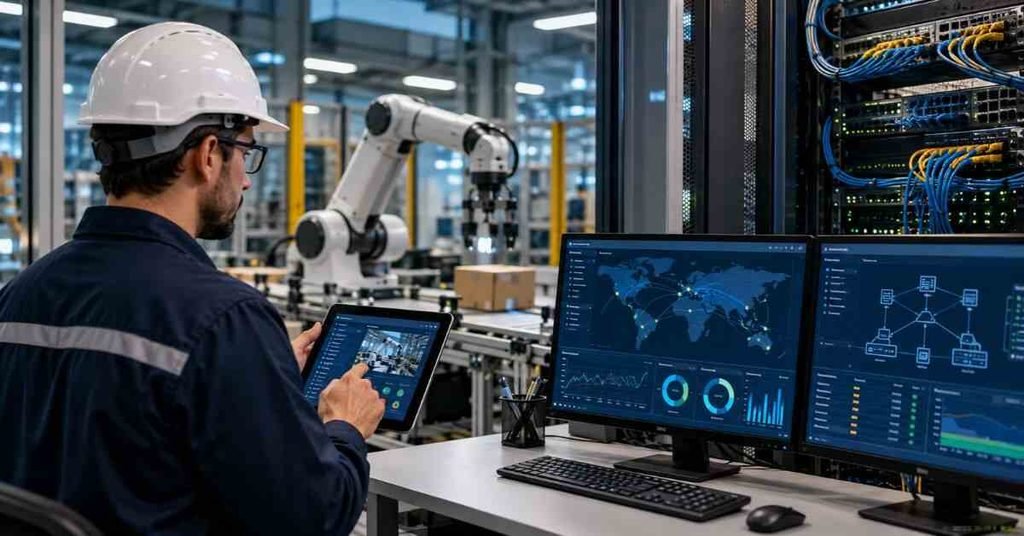
Organizations should introduce these technologies through controlled, measurable projects rather than attempting to automate an entire enterprise network or factory at once. A successful implementation starts with a specific operational problem, a defined safety boundary, and reliable baseline measurements.
Step 1: Identify a Suitable Use Case
Start by identifying a task that has measurable costs or recurring operational problems. Suitable candidates include warehouse navigation, visual quality inspection, network incident triage, wireless troubleshooting, and automated collection of infrastructure diagnostics.
Avoid selecting a use case merely because it involves AI. A deterministic script may be cheaper, faster, and easier to validate when the task has fixed inputs and predictable outcomes.
Step 2: Assess Network and Data Readiness
Before deployment, verify that the underlying infrastructure can support the workload. Assess switch capacity, wireless coverage, uplink utilization, application latency, telemetry availability, and the reliability of connections between edge devices and management platforms.
Evaluate sensor quality, local computing capacity, environmental conditions, and consequences of loss of connectivity for physical AI. Document existing network dependencies so that the new system does not introduce an unrecognized single point of failure.
Step 3: Build the AI and Control Architecture
Choose where each task should execute. A useful starting design keeps time-sensitive inference and control close to the machine, while using centralized services for model management, reporting, historical analysis, and tasks that tolerate additional latency.
For networking workflows, connect the AI assistant to approved telemetry sources and read-only diagnostic tools first. Add configuration-writing capabilities only after testing the assistant’s recommendations against known incidents and enforcing authorization policies.
Step 4: Validate in Simulation and Staging
Physical AI systems should be evaluated against varied environmental conditions before entering production. Simulation can help test navigation, obstacle avoidance, equipment interactions, and unusual operating conditions, but simulated performance must be checked against real-world results.
Network AI requires a similar validation process. Replay historical incidents, introduce controlled faults in a staging environment, and check whether the system identifies the correct cause without recommending disruptive changes.
Step 5: Introduce Controlled Automation
Begin with recommendations that require human approval. Once the system demonstrates consistent performance, permit narrowly scoped automated actions, such as collecting diagnostic information or executing preapproved recovery workflows.
Every action should have a clear authorization boundary, a recorded execution history, and a tested rollback path. Expand the scope only when evidence shows that the additional automation improves operational results without increasing unacceptable risk.
Step 6: Monitor and Improve
After deployment, compare actual outcomes with the original baseline. Review failure cases, false alarms, missed incidents, model drift, network changes, and the time employees spend reviewing AI-generated recommendations.
Physical AI also requires ongoing assessment of sensor calibration, mechanical wear, changing environmental conditions, and the gap between simulated and real-world performance.
5. Performance Metrics, Implementation Bottlenecks, and ROI
The business case for generative AI in enterprise networking and physical AI should be based on measured results, not vendor demonstrations or projected productivity gains alone. Organizations need to evaluate technical performance, operational reliability, and total cost of ownership together.
Which Performance Metrics Matter?
For enterprise networking, useful measurements include mean time to resolution (MTTR), incident detection time, packet loss, latency, change failure rate, and the percentage of incidents correctly diagnosed. Track the proportion of AI recommendations accepted by engineers and the number of changes that require rollback.
For physical AI, relevant measurements include task completion rate, successful navigation, intervention frequency, inspection accuracy, throughput, and safe-stop behavior. Latency should be measured at the relevant point in the control loop rather than inferred from average network response time.
There is no universal latency threshold for physical AI. A robotic control loop, a warehouse coordination service, and a cloud-based inspection report have different timing requirements; each needs a workload-specific service objective.
Common Deployment Bottlenecks
Poor data quality: Incomplete logs, inconsistent timestamps, missing device inventory, and inaccurate asset relationships can undermine an otherwise capable model.
Legacy integration: Older industrial controllers and network devices may lack modern APIs, consistent telemetry, or sufficient computing capacity. Protocol gateways and additional instrumentation can increase both complexity and cost.
Latency and bandwidth: Video feeds and frequent sensor updates can consume significant network resources. Local processing, selective data transmission, traffic prioritization, and capacity planning help address these constraints.
Model reliability: Generative models can produce incorrect explanations or unsupported recommendations. Physical AI models may also fail when objects, lighting, environmental conditions, or operating patterns differ from their training data.
Operational resistance: Engineers may distrust systems that cannot explain their recommendations or that create extra review work. Training, transparent evidence, and well-defined escalation procedures are necessary for adoption.
Cost and Return on Investment
The cost model should include hardware, connectivity upgrades, software subscriptions, integration, data engineering, security testing, employee training, ongoing maintenance, and incident response. Physical AI projects may also require simulation environments, robotic equipment, safety validation, and changes to factory layouts.
A straightforward ROI model is:
\[ \text{ROI}=\frac{\text{Annual Net Benefit}}{\text{Total Investment}}\times100\% \]
Annual net benefit should account for measurable savings after recurring operating expenses. Avoid counting the same productivity improvement twice, and distinguish cash savings from capacity gains that may not immediately reduce spending.
For example, assume an AI-assisted network operations project costs $120,000 to deploy and saves $60,000 annually in net operating costs. Its simple payback period is two years, and its annualized net benefit equals 50% of the initial investment, assuming the savings remain stable.
These figures are illustrative, not a forecast for a specific vendor or enterprise. Actual returns depend on incident volumes, labor costs, deployment scale, and the reliability of the resulting workflows.
6. Security, Governance, and the Future of Intelligent Infrastructure
Connecting AI models to enterprise infrastructure changes the security risk profile. A model that can read telemetry has different exposure from an agent that can modify routing policies, and a robot that can receive movement commands presents different risks from a dashboard that only generates reports.
Technical Note & Security Considerations
- Apply Zero Trust Principles: Verify identities and permissions for users, machines, services, and AI agents. Grant each component only the access required for its assigned task.
- Separate IT and OT: Segment industrial controllers, robots, corporate networks, and AI management services. Restrict traffic to explicitly authorized communication paths.
- Protect Sensitive Data: Control access to network configurations, industrial telemetry, video streams, customer information, and operational logs. Define retention and data-sharing policies before connecting external AI services.
- Defend Against Prompt Injection: Treat device descriptions, log messages, retrieved documents, and external inputs as untrusted data. They must not be allowed to override system instructions or authorization policies.
- Validate Every High-Impact Action: Use schema checks, policy enforcement, configuration simulation, change approval, and rollback procedures before modifying production infrastructure.
- Preserve Independent Safety Controls: Physical AI must not be able to bypass emergency stops, certified safety functions, or required human supervision.
- Maintain Auditability: Record the evidence behind decisions, model and policy versions, approvals, commands executed, and the outcome of each action.
The National Institute of Standards and Technology (NIST) AI Risk Management Framework provides guidance for managing AI risks across design, development, deployment, and evaluation. Its risk-management principles can help organizations establish governance and testing requirements for infrastructure-related AI systems.
Industrial environments also need controls suited to operational technology’s availability and safety requirements. NIST’s operational technology security guidance discusses the protection of systems that monitor or directly affect physical processes.
What Comes Next for Physical AI and Enterprise Networking?
The next stage is likely to involve closer coordination between autonomous machines, edge computing, and AI-assisted network operations. A factory may use physical AI to detect a production problem while its network operations platform investigates connectivity issues affecting the relevant machines.
In a well-designed architecture, these systems exchange approved operational signals without giving one AI component unrestricted control over another. For example, a robot fleet manager could report connectivity degradation, while the networking platform investigates wireless interference and recommends a channel adjustment for an engineer to approve.
This type of coordination could reduce the time needed to investigate problems across traditionally separate IT, networking, and OT teams. Its value will depend on interoperable systems, dependable telemetry, clear ownership, and well-tested automation boundaries.
Enterprises should expect gradual adoption rather than assume that every machine or network will become fully autonomous in 2026. The organizations most likely to benefit will be those that combine AI capabilities with sound engineering practices, clear governance, and measurable operating objectives.
Conclusion
Understanding what is physical AI helps explain why artificial intelligence is moving beyond software applications into factories, warehouses, robotics, and other physical environments. At the same time, generative AI in enterprise networking is changing how infrastructure teams investigate incidents, interpret telemetry, and manage complex connectivity requirements.
These technologies are most effective when deployed as complementary parts of a carefully designed system. Physical AI requires dependable connectivity and appropriate edge computing, while AI-assisted networking needs accurate data, controlled permissions, and reliable mechanisms for validating operational changes.
For technology leaders, the practical next step is to select a narrow use case, establish measurable performance targets, test the architecture in a controlled environment, and expand automation only when the results justify it. Security segmentation, human oversight, independent safety controls, and clear rollback procedures should remain central to the deployment.
Final Thoughts
As intelligent machines become more capable, the distinction between IT infrastructure and physical operations will continue to narrow. Businesses that prepare their networks, data systems, and governance processes now will be better positioned to adopt these capabilities responsibly.
Tech Sprinto will continue exploring the technologies, architectures, and practical engineering decisions shaping enterprise AI, networking, and industrial innovation in 2026 and beyond.
Physical AI is artificial intelligence that enables machines to perceive their surroundings, make decisions, and act in the real world. Examples include autonomous robots, intelligent industrial machines, and self-driving vehicles.
Generative AI creates or interprets content such as text, images, and code, while physical AI focuses on interacting with the physical environment. A system can combine both technologies when a generative model helps a robot understand instructions or plan a task.
Generative AI is helping network teams interpret telemetry, investigate incidents, summarize logs, and prepare configuration changes. When integrated with approved automation tools, it can also support controlled remediation and multistep troubleshooting workflows.
Yes. Physical AI systems can perform selected tasks locally when their models, sensors, computing resources, and control software are available on the device or nearby edge infrastructure. However, some features may still require remote services, centralized coordination, or cloud-based processing.
Companies such as NVIDIA, Cisco, Juniper Networks, and AWS provide technologies that support different parts of these architectures, from robotics and accelerated computing to network infrastructure, management, and cloud services. Their suitability depends on the specific workload, existing systems, security requirements, and integration needs.
