
Introduction
Enterprise networks have become harder to operate as businesses how do AI agents work adopt cloud applications, hybrid work, distributed data centers, software-defined wide area networks (SD-WAN), and artificial intelligence workloads. A single performance complaint may involve wireless interference, DNS resolution, routing, firewall policies, application dependencies, or a congested link between two cloud environments.
Traditional monitoring systems can detect many of these problems, but detection does not always explain the underlying cause. Network engineers still need to correlate telemetry, inspect logs, validate configurations, and determine which corrective action will restore service without creating another problem.
This is where AI agents and generative AI in enterprise networking are beginning to change network operations. Rather than limiting automation to predefined rules, AI-enabled systems can interpret requests, gather relevant evidence, evaluate possible causes, and recommend or execute approved actions through connected tools.
By 2026, networking vendors are increasingly combining conversational AI, machine learning, telemetry analysis, and agent-based automation. Cisco’s Crosswork AI, for example, describes specialized agents for network operational tasks, while HPE Juniper Networking’s Marvis AI Assistant combines conversational interaction with network insights and agentic operations. These products illustrate the direction of the industry, although their features and automation permissions differ.
Understanding how do AI agents work is therefore useful for network architects, IT directors, infrastructure engineers, and security teams evaluating intelligent operations. This guide explains the underlying architecture, how generative AI fits into the workflow, where enterprise deployments can deliver value, and which technical controls are necessary before allowing an AI agent to change production infrastructure.
1. How Do AI Agents Work in Enterprise Networking?
What Is an AI Agent?
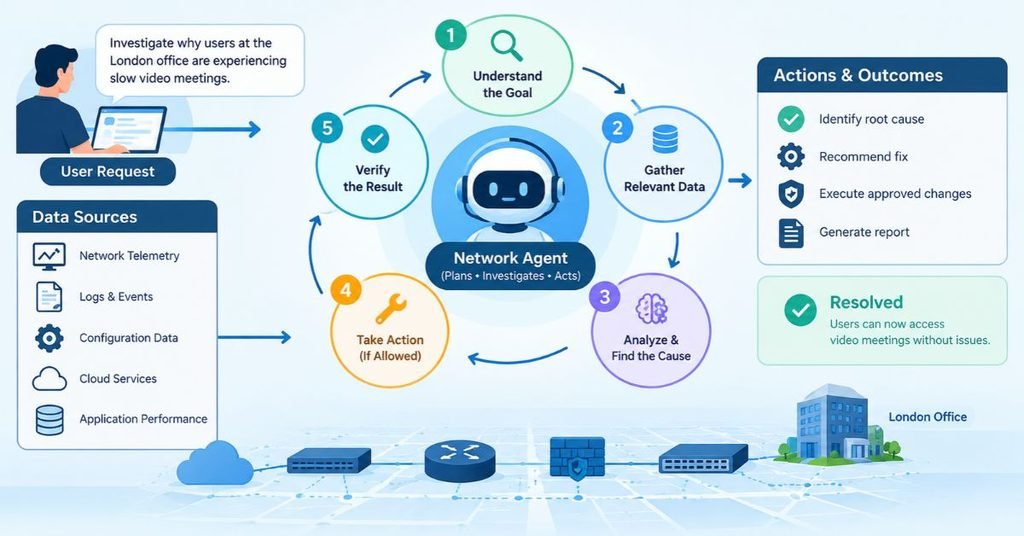
An AI agent is a software system that receives an objective, gathers information, reasons about possible next steps, and uses permitted tools to pursue that objective. Unlike a conventional chatbot that primarily generates responses, an agent can participate in a multi-step workflow and evaluate whether its actions achieved the intended result.
For example, a network engineer might ask an agent to investigate why employees at a particular office are experiencing slow video meetings. how do AI agents work The agent could retrieve wireless client statistics, inspect packet loss and latency measurements, examine recent configuration changes, and correlate the results with application performance data.
The agent may then identify a likely cause and propose a targeted remediation. If the organization has authorized automated changes for that specific scenario, it may execute the approved operation and verify the outcome.
However, an agent is not automatically reliable simply because it uses an advanced language model. Its effectiveness depends on the quality of its data, the tools it can access, the restrictions placed on its actions, and the reliability of its verification process.
The Core Components of an AI Agent
Most practical enterprise agents combine several architectural components rather than relying on a language model alone.
1. Goal interpretation: The system converts a natural-language request into a specific objective, such as diagnosing packet loss on a branch-office connection.
2. Context and data retrieval: It collects relevant information from monitoring platforms, configuration repositories, ticketing systems, network controllers, and technical documentation.
3. Reasoning and planning: A language model or other decision-making component determines which evidence is needed and selects an appropriate sequence of investigative steps.
4. Tool execution: The agent invokes authorized APIs, queries telemetry platforms, runs approved diagnostic commands, or submits a change request.
5. Validation and feedback: It checks whether the evidence supports its diagnosis and whether the requested result has been achieved.
These components form a controlled loop: observe, interpret, plan, act, and verify. Depending on the design, the agent may repeat the loop several times before reporting its findings.
How an AI Agent Differs From a Traditional Network Script
A traditional script usually follows explicit instructions. For instance, a Python script might check whether a router responds to a ping and open a ticket if the response fails.
An AI agent can work at a higher level of abstraction. It might receive the objective of investigating an unreachable application and decide to inspect routing, DNS, firewall events, and recent changes before recommending a response.
| Capability | Traditional automation | AI agent |
| Decision process | Predefined rules | Model-assisted planning with constraints |
| Input | Structured events and parameters | Structured data and natural-language goals |
| Investigation | Predetermined checks | Context-dependent tool selection |
| Handling unfamiliar cases | Requires new logic | May propose a new investigation path |
| Change execution | Script-defined actions | Authorized tool calls, often with approval |
| Verification | Explicitly programmed checks | Evidence-based checks designed into the workflow |
| Main risk | Incorrect rules or unexpected inputs | Incorrect reasoning, tool misuse, or unreliable output |
AI agents do not eliminate conventional automation. They often depend on it for reliable execution, deterministic checks, and repeatable configuration changes.
Single-Agent and Multi-Agent Architectures
A single-agent architecture assigns investigation, planning, and reporting to one agent. It is easier to deploy, monitor, and secure, making it a sensible starting point for organizations exploring AI-assisted operations.
A multi-agent architecture separates responsibilities among specialized agents. One agent might analyze telemetry, another might examine configuration changes, and a third might evaluate security implications before a coordinating component produces a recommendation.
Cisco’s Crosswork AI describes a specialized agent framework for network operations, including configuration drift remediation and performance troubleshooting. This illustrates how agent responsibilities can be separated by operational purpose rather than concentrated in one general-purpose assistant.
Multi-agent designs can improve modularity, but they also introduce coordination overhead, additional permissions, more complex debugging, and potential disagreements between agents. Multiple agents do not automatically produce more accurate decisions; their value depends on the quality of their responsibilities and evidence.
2. How Generative AI in Enterprise Networking Changes Network Operations
From Command-Line Troubleshooting to Natural-Language Investigation
Network engineers traditionally interact with routers, switches, firewalls, and management systems through command-line interfaces, dashboards, and vendor-specific workflows. Generative AI introduces a conversational interface that can translate an operational question into structured investigations across those systems.
An engineer could ask, “Why are users at the London office experiencing intermittent connectivity?” The assistant could use approved data sources to identify affected clients, inspect relevant service-level indicators, and summarize possible causes with supporting evidence.
This is particularly useful when an incident spans multiple technologies and the engineer must switch between monitoring dashboards, documentation, configuration tools, and ticketing platforms. The AI layer can reduce the effort required to assemble a coherent picture of the incident.
HPE Juniper Networking’s Marvis AI Assistant provides an example of this approach, combining natural-language interaction with insights across wireless, wired, WAN, and other supported network domains. Its capabilities depend on the deployed products, integrations, and enabled features.
Intelligent Root-Cause Analysis
Root-cause analysis is one of the most useful applications of AI-assisted network operations. Monitoring systems may produce thousands of events during an incident, even when only a small number of underlying failures are responsible.
Machine learning can identify anomalies and correlate related events, while generative AI can summarize the evidence in language that engineers can review. An agent can then investigate a hypothesis by querying additional data sources and comparing current conditions with historical baselines.
Consider a branch office where users report slow access to a cloud-based business application. The agent might discover elevated wireless retries, normal WAN latency, and a recent access-point configuration change.
Rather than immediately declaring the configuration change responsible, a reliable system would distinguish observed facts from hypotheses, gather additional evidence, and identify what remains uncertain. This reduces the risk of treating a correlation as proof of causation.
Configuration Generation and Change Assistance
Generative AI can help engineers draft device configurations, explain existing settings, translate operational requirements into configuration templates, and produce proposed changes through approved automation systems.
For example, an engineer might request a new segmented network for a group of application servers. An AI assistant could help draft the VLAN, routing, access-control, and monitoring requirements using organizational templates and established configuration standards.
The output must still be validated against device capabilities, addressing plans, security policies, dependencies, and the current network state. A syntactically correct configuration can still create a routing loop, expose an internal service, or interrupt a production application.
The safest approach is to use generative AI to accelerate preparation while established tools handle schema validation, policy enforcement, configuration testing, deployment, and rollback.
Predictive Operations and Proactive Remediation
AI-enabled monitoring can analyze patterns in interface errors, wireless performance, link utilization, device health, and application experience. When the system detects a developing problem, it can prioritize the affected service and recommend preventive action.
Juniper’s Mist platform, for example, uses network telemetry and AI-driven insights to identify issues and improve user experience across supported environments. Its documentation also describes digital-experience simulation capabilities that help validate connectivity without requiring an affected end user to be present.
Generative AI adds a communication and workflow layer to these analytical capabilities. It can explain why a warning matters, summarize the evidence, and prepare a remediation plan for an engineer or an authorized automation system.
Prediction should not be confused with certainty. Forecasts need confidence thresholds, historical validation, and clear escalation paths, especially when a false positive could trigger an unnecessary network change.
3. The Technical Architecture Behind AI-Powered Enterprise Networking
Data Collection and Network Observability
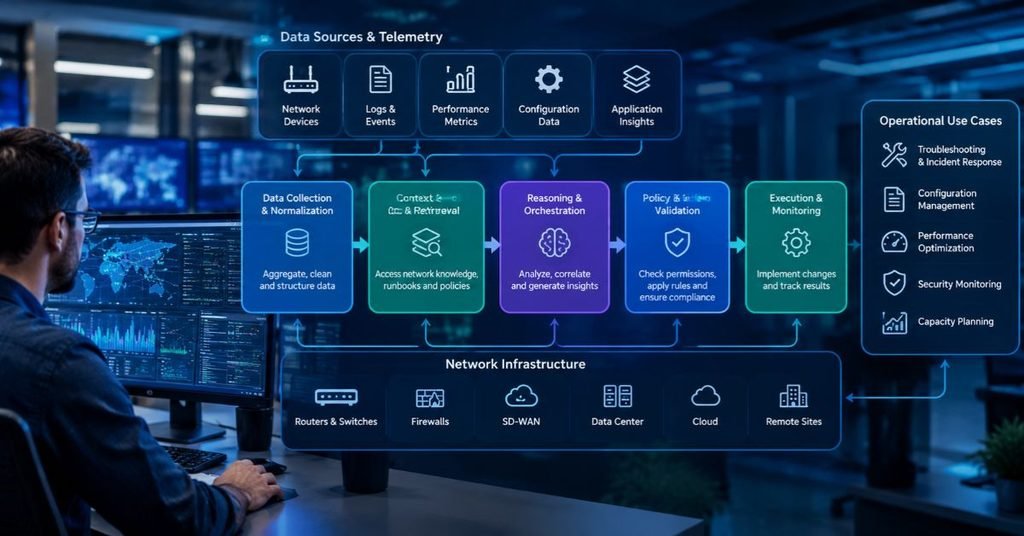
A reliable AI agent needs a trustworthy view of the infrastructure it manages. The data layer may include network telemetry, SNMP measurements, streaming telemetry, syslog events, flow records, packet captures, configuration snapshots, routing information, and application performance metrics.
For enterprise deployments, these sources should be normalized and correlated with device identity, location, timestamps, service ownership, and configuration history. Without that context, an agent may incorrectly combine unrelated events or overlook the relationship between a network change and a user-facing failure.
Data freshness also matters. A routing table collected several minutes ago may be adequate for historical analysis but unsuitable for deciding whether a production route is currently safe to modify.
The Language Model and Retrieval-Augmented Generation
A large language model (LLM) interprets requests, summarizes evidence, and helps coordinate multi-step investigations. However, the model’s training data is not a substitute for current network state, internal architecture documents, or organization-specific security policies.
Retrieval-augmented generation (RAG) addresses part of this problem by retrieving relevant information from approved sources and providing it to the model when answering a question. Those sources may include network runbooks, vendor documentation, approved configuration templates, and internal incident records.
For example, if an engineer asks whether a switch supports a particular feature, the system can retrieve the applicable hardware documentation and software-version requirements instead of relying solely on the model’s general knowledge.
RAG improves access to relevant evidence, but it does not guarantee a correct answer. Documents may be outdated, retrieval may return irrelevant passages, and a model may still misinterpret the information. Source citations, version metadata, and verification checks remain necessary.
API Integration and the Network Control Plane
An agent becomes operationally useful when it can interact with approved enterprise tools. These integrations may include network controllers, cloud management APIs, identity systems, IT service management platforms, and configuration automation frameworks.
The architecture should separate the reasoning layer from the privileged execution layer. Instead of giving a language model unrestricted access to device credentials, the system should expose narrowly defined tools such as get_interface_status, query_client_health, or validate_change.
Each tool should validate its inputs, enforce authorization, record its actions, and return structured results. Write operations should use explicit policy checks, and high-impact changes should require human approval.
NVIDIA’s enterprise AI software ecosystem illustrates the broader infrastructure requirements of production AI, including deployment components, orchestration, and support for agent development. Networking integrations must be engineered separately; an enterprise AI platform does not automatically provide safe control of every network device.
Verification, Rollback, and Auditability
The control plane must determine whether an action actually improved the network. After a change, an agent should check the relevant service indicators, compare them with the baseline, and detect unexpected side effects.
For a wireless remediation, this could mean checking client connectivity, retry rates, authentication failures, and application performance. For a routing change, verification might include reachability tests, route validation, and checks that critical traffic still follows the intended path.
If the post-change state violates a defined safety condition, the automation system should halt further changes and invoke an approved rollback procedure where feasible. Every decision should be linked to its evidence, policy evaluation, approval, action, and verification result.
4. Real-World Enterprise Networking Use Cases in 2026
Data Center Networking for AI Workloads
AI training and inference place demanding requirements on data center networks. Distributed workloads may exchange substantial volumes of data among accelerators, storage systems, and compute nodes, making congestion, packet loss, and uneven traffic distribution expensive operational problems.
AI-assisted operations can help correlate congestion events, identify configuration inconsistencies, analyze link utilization, and recommend capacity or topology changes. NVIDIA’s networking and AI infrastructure documentation describes specialized components for connecting accelerated computing systems and managing network resources in Kubernetes environments.
In these environments, the objective is not simply to make a dashboard easier to use. It is to maintain the network conditions required for predictable workload performance while protecting the availability of the underlying infrastructure.
Enterprise Wi-Fi and Campus Networks
Large campuses generate a continuous stream of client associations, authentication events, radio measurements, roaming activity, and application performance data. A user reporting poor connectivity may be affected by a weak signal, interference, authentication delays, an overloaded access point, or a problem beyond the wireless network itself.
An AI-enabled assistant can correlate these signals, identify affected users, and suggest a focused investigation. It may also help service-desk teams turn technical findings into clear incident updates without requiring every support employee to understand complex wireless diagnostics.
The key benefit is better visibility into user experience, rather than relying only on whether an access point or switch appears operational.
SD-WAN and Hybrid Cloud Connectivity
Distributed organizations need consistent connectivity between branch offices, data centers, and public cloud environments. Their networks may use multiple transport links, encrypted tunnels, application-aware routing, and different service providers.
An AI agent can compare path performance, investigate packet loss, review policy changes, and recommend whether traffic should move to an alternate link. Before changing traffic paths automatically, the system must account for application requirements, contractual service levels, security controls, and the costs of alternate connectivity.
A sensible initial deployment provides recommendations and evidence while the existing SD-WAN controller continues to enforce routing policy.
Network Security and Configuration Compliance
AI agents can support security teams by finding configuration drift, identifying exposed management interfaces, summarizing suspicious events, and comparing device settings with approved baselines. They can also help investigate whether a change introduced an unintended access path.
However, an AI agent should not become an unrestricted security administrator. A mistaken firewall rule or access-control change can interrupt critical services or expose sensitive systems.
Security-related automation should therefore use explicit authorization, policy validation, change logging, and human approval for high-impact actions. An AI-generated explanation is useful evidence for an investigation, not a replacement for the underlying security logs.
5. How to Implement AI Agents in an Enterprise Network
A successful deployment begins with a narrow operational problem and expands only after the organization can demonstrate reliable results.
Step 1: Select a Measurable Use Case
Start with a repetitive, well-understood task such as summarizing incidents, investigating interface errors, correlating alerts, or answering questions about approved network documentation.
Define the baseline before deployment. Record how long the task takes, how often engineers reach the correct diagnosis, and how many incidents require escalation or repeat investigation.
Avoid starting with unrestricted autonomous configuration changes. A small, measurable use case makes it easier to establish trust and identify weaknesses before expanding the system’s permissions.
Step 2: Establish Data Quality and Access Boundaries
Identify the telemetry, logs, configuration repositories, and documentation the agent actually needs. Assign ownership to each data source and document how frequently it updates.
Use read-only access initially, with separate service identities and limited permissions for each integration. how do AI agents work Exclude secrets, unnecessary personal information, and sensitive payloads from model context wherever possible.
Step 3: Connect the Agent to Validated Tools
Build integrations around structured APIs and approved automation workflows rather than allowing the model to generate arbitrary device commands and execute them directly.
Tool responses should include the device identity, collection timestamp, operation status, and relevant errors. how do AI agents work The system should reject malformed inputs and block requests that fall outside the agent’s assigned scope.
Step 4: Test Against Historical Incidents
Replay known incidents and compare the agent’s findings with verified engineering outcomes. Include ordinary failures, ambiguous symptoms, missing telemetry, misleading alerts, and scenarios in which the correct decision is to request more information.
Measure false diagnoses, unsupported claims, unnecessary tool calls, and unsafe recommendations. how do AI agents work Test whether the agent can recognize insufficient evidence instead of producing a confident but incorrect answer.
Step 5: Introduce Human-Approved Remediation
Once diagnostic performance is acceptable, allow the agent to prepare proposed changes for review. how do AI agents work An engineer or authorized change-management process should validate the expected impact, implementation window, rollback plan, and compliance requirements.
Only consider automatic execution for low-risk, well-defined actions after successful testing and formal approval. Keep critical routing, firewall, identity, and production availability controls outside the agent’s discretionary authority.
Step 6: Monitor, Audit, and Improve
Track the agent’s recommendations, tool calls, approvals, execution outcomes, and verification results. how do AI agents work Review failures regularly and update runbooks, data mappings, policies, and tests when the underlying environment changes.
Model versions and prompts can affect behavior, so changes to either should be evaluated before production rollout. how do AI agents work Treat the agent as a software system that requires lifecycle management, not as a one-time installation.
6. Performance Metrics, Implementation Bottlenecks, and ROI
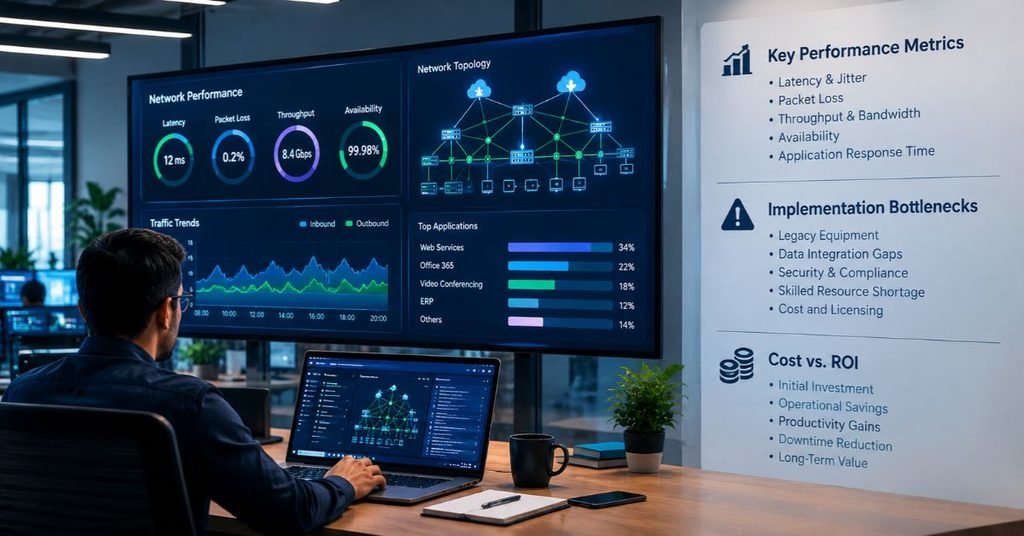
The value of generative AI in enterprise networking should be measured by operational outcomes, not by the number of conversations an assistant completes.
Key Performance Indicators
Mean Time to Resolution (MTTR)
Measure the elapsed time from incident detection to verified service restoration. Separate the time spent diagnosing the incident from the time spent implementing and validating a fix.
Diagnostic Accuracy
Compare agent-generated root-cause findings against verified incident outcomes. Track incorrect conclusions and unsupported recommendations, not only successful cases.
Change Success and Rollback Rates
Monitor the percentage of approved changes that pass validation, the frequency of rollbacks, and any incidents caused by automated actions.
Cost per Resolved Incident
Compare labor, model inference, platform subscriptions, integration maintenance, and incident-related downtime before and after deployment.
Latency, Scale, and Reliability Bottlenecks
Agent-based workflows often involve multiple sequential tool calls. The total response time includes model inference, telemetry retrieval, API execution, external service latency, and any required approval or validation steps.
A workflow that requires numerous unnecessary calls can be slower and more expensive than a conventional script. Organizations should use parallel queries where safe, cache stable reference information, set timeouts, and impose limits on the number of steps an agent can perform.
Data quality is another major constraint. how do AI agents work Missing timestamps, inconsistent device identifiers, stale inventory records, and incomplete telemetry can undermine the entire investigation, regardless of model quality.
Understanding Cost and Return on Investment
An enterprise business case should account for both direct expenses and operational savings. The following calculation is a planning example, not a forecast or a claim about any particular vendor’s performance.
Assume a network team investigates 500 incidents per month, spending an average of 40 minutes per incident. If an AI-assisted workflow reduces that effort by 25%, it saves 83.3 engineering hours per month, approximately 1,000 hours per year.
At an illustrative fully loaded labor cost of $60 per hour, the gross annual labor capacity released is approximately $60,000. This is not automatically cash savings: the benefit depends on whether the organization can redirect the freed time toward valuable work or reduce actual expenditure.
| ROI component | Illustrative annual value |
| Engineering time released | 1,000 hours |
| Loaded labor rate | $60/hour |
| Gross labor capacity value | $60,000 |
| AI platform and inference costs | $18,000 |
| Integration and maintenance | $12,000 |
| Training and governance | $5,000 |
| Estimated net annual benefit | $25,000 |
| Net benefit / listed annual costs | 71.4% |
The example assumes the listed costs are annual and excludes potential savings from reduced downtime, licensing changes, and incident avoidance. how do AI agents work It also excludes initial implementation costs beyond the stated categories if those costs are not already covered.
The formula is:
ROI=AnnualBenefits-AnnualCostsAnnualCosts100
Using the example above, ROI is (60,000-35,000)/35,000100, or approximately 71.4%. Before approving a project, validate the assumptions with a pilot and distinguish realized financial savings from engineering capacity that has merely been released.
7. Technical Note & Security Considerations
AI agents that can inspect and modify enterprise infrastructure introduce risks beyond those associated with a conventional chatbot. Their permissions, data sources, execution tools, and decision-making workflows must be secured as part of the enterprise control plane.
- Zero Trust Access: Authenticate every integration, apply least-privilege permissions, and restrict agents to explicitly authorized resources and operations.
- Prompt Injection: Treat retrieved documents, tickets, logs, and external content as untrusted input. Malicious instructions embedded in those sources must not override system policies or grant additional privileges.
- Data Privacy: Review where prompts, telemetry, configuration data, and diagnostic logs are processed and retained. Apply organizational requirements for data residency, confidentiality, and regulated information.
- Change Safety: Require policy validation and human approval for high-impact changes. Maintain tested rollback procedures and independent post-change verification.
- Credential Protection: Store secrets in an approved secrets-management system. Never expose administrator passwords, API tokens, or private keys directly to the model.
- Auditability: Record the evidence used, tool calls made, approval decisions, configuration changes, and verification results. Protect audit records from unauthorized modification.
- Availability and Latency: Define execution timeouts, rate limits, retry policies, and emergency stop mechanisms. Prevent an agent from repeatedly changing a network that is already unstable.
Critical Rule: Never allow an AI agent to bypass established change management, identity controls, or network security policies simply because it presents a convincing explanation. The execution layer must enforce these controls independently of the model.
Conclusion
The next phase of enterprise networking will involve a closer relationship between network observability, generative AI, and controlled autonomous operations. how do AI agents work AI agents can help engineers investigate incidents faster, understand complex dependencies, prepare configuration changes, and coordinate workflows that previously required switching between multiple tools.
However, successful adoption will depend less on the sophistication of a language model alone and more on the quality of the surrounding architecture. Reliable telemetry, accurate configuration inventories, secure API integrations, policy enforcement, and measurable verification must remain the foundation of every production deployment.
For network architects and IT leaders, the practical next step is to choose one repetitive operational task, establish baseline performance, and test an AI-assisted workflow using read-only access. Expand toward approved remediation only after the system demonstrates consistent results under realistic failure conditions.
Final Thoughts
Organizations should also evaluate vendor-specific capabilities against their existing infrastructure, security requirements, integration costs, and operational skills before committing to a platform.
At Tech Sprinto, our goal is to help technology professionals understand emerging systems through practical explanations, technical analysis, and implementation-focused guidance. As AI agents continue to influence network operations in 2026 and beyond, the strongest enterprise strategies will combine intelligent automation with disciplined engineering, accountable decision-making, and security by design.
AI agents receive a goal, gather relevant information, plan their next steps, and use approved tools to complete a task. They can repeat this process until they reach a verified result, encounter a restriction, or determine that human assistance is necessary.
Generative AI produces content such as explanations, summaries, and configuration drafts in response to input. An AI agent uses a model or other decision-making logic to pursue a goal through a sequence of actions, often by connecting generative AI to APIs, data sources, and execution tools.
Generative AI can assist with incident investigation, configuration drafting, documentation searches, root-cause summaries, and natural-language network management. When combined with reliable telemetry and controlled automation, it can also support proactive remediation and multi-step operational workflows.
Yes, if they are integrated with suitable management APIs or automation systems and explicitly authorized to perform configuration changes. Production deployments should validate proposed changes, enforce policy restrictions, retain rollback options, and require human approval for high-risk operations.
Cisco provides AI-related network operations capabilities through offerings including Crosswork AI. HPE Juniper Networking offers Marvis AI Assistant and Mist AI capabilities for supported network environments. NVIDIA provides AI infrastructure and networking technologies that support demanding AI workloads, although these products serve different operational purposes.
