
Introduction
Enterprise technology teams face a difficult combination of demands: organizations want faster operations, more reliable infrastructure, stronger cybersecurity, and greater automation, but they must deliver these improvements without allowing costs or operational risks to spiral out of control. AI in Robotics At the same time, manufacturers are introducing more intelligent robots, while enterprises are exploring generative AI to simplify the management of increasingly complex networks.
AI in Robotics and generative AI in enterprise networking address different technical problems, yet both follow a similar principle: use data, computational models, and controlled decision-making to improve how complex systems operate. In robotics, AI can help machines recognize objects, interpret sensor readings, plan movements, and adapt to changing environments. In networking, generative AI can help engineers investigate faults, interpret configurations, explain telemetry, and develop proposed remediation steps.
These capabilities matter in 2026 because businesses increasingly operate connected environments that include cloud services, edge computing, industrial equipment, distributed offices, and AI workloads. A failure in one part of this environment can affect production lines, customer-facing applications, warehouse operations, or critical business services.
However, adding an AI model does not automatically make a robot autonomous or a network self-managing. Reliable deployment requires suitable data, appropriate models, secure integrations, measurable performance targets, and clear boundaries around automated actions.
This guide examines both technologies, explains how they work, compares their architectures, and explores practical enterprise applications. It also covers implementation steps, performance measurement, financial considerations, vendor examples, and security controls that IT leaders should evaluate before deploying these systems.
Understanding AI’s measurable operational value, traditional engineering’s necessity, and how organizations can introduce intelligent automation without compromising safety, reliability, and security is the objective.
1. AI in Robotics: How Intelligent Machines Work
AI in Robotics combines artificial intelligence with mechanical systems, sensors, actuators, and software to enable machines to perform tasks that require perception, planning, or adaptation. Traditional industrial robots typically follow predefined instructions, while AI-enabled robots can use sensor data and learned models to respond to variations in their surroundings.
This distinction matters in manufacturing, logistics, healthcare, agriculture, and inspection, where operating conditions are rarely identical every time a task is performed.
The Core Architecture of an AI-Powered Robot
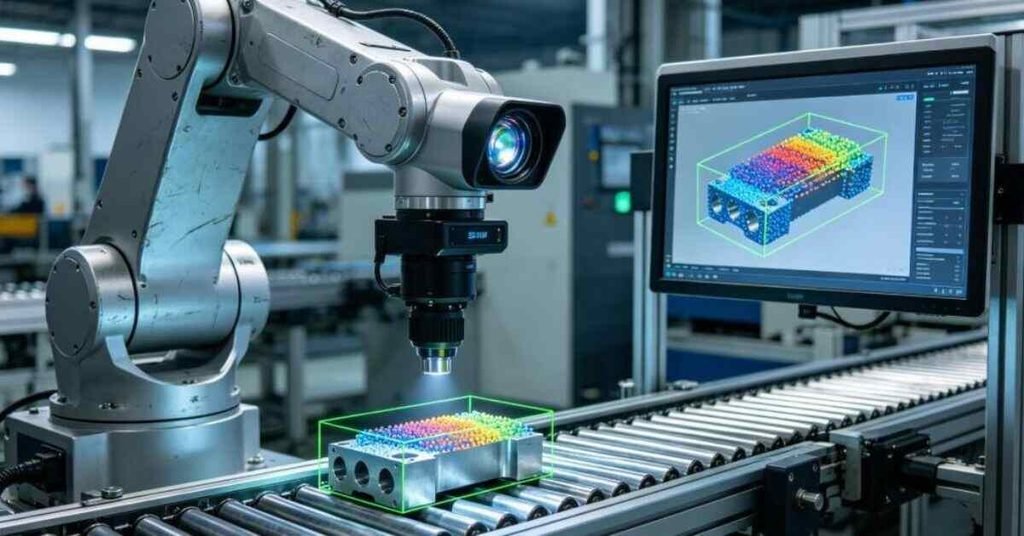
An AI-powered robot usually consists of several interconnected layers. Each layer performs a specific function, and the system’s reliability depends on how effectively these components exchange information.
- Perception layer: Cameras, depth sensors, LiDAR, encoders, and other devices collect information about the environment.
- AI inference layer: Computer vision models, neural networks, and other machine-learning systems interpret sensor data and identify objects, obstacles, or task requirements.
- Planning layer: Planning software determines a suitable sequence of movements or operations based on the robot’s objective and constraints.
- Control layer: Real-time controllers convert approved plans into motor commands while enforcing movement limits and safety conditions.
- Feedback layer: Sensors confirm what happened and help the system correct deviations.
In addition, generative AI can interpret complex instructions and assist in generating plans, task sequences, simulation scenarios, or robot behavior. It does not eliminate the need for deterministic motion control.
For example, a warehouse operator might instruct a robot to move fragile packages from a mixed pallet to a designated station. A vision-language model could help identify the relevant packages and translate the request into structured tasks, while conventional robotics software handles trajectory planning and controlled movement.
Real-World Applications of AI in Robotics
1. Manufacturing and assembly: AI-driven vision systems help robots locate components, inspect products, and adapt to variations in part placement. In electronics manufacturing, this can support defect detection and precise handling, although high-speed assembly still depends on carefully engineered motion systems.
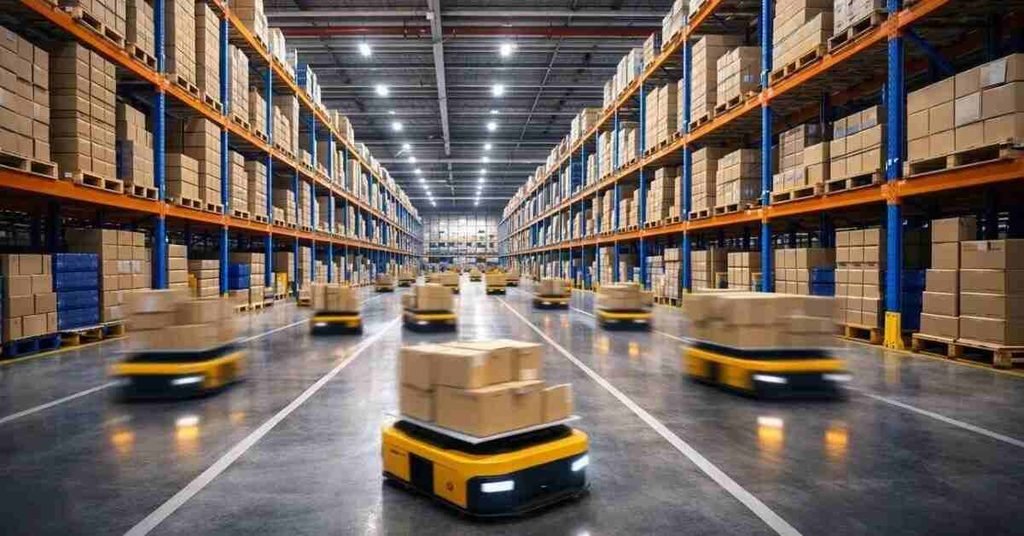
2. Warehousing and logistics: Autonomous mobile robots can navigate facilities, transport inventory, and coordinate with warehouse management systems. AI can improve object recognition and task allocation, but congestion, blocked routes, and unreliable wireless coverage remain operational concerns.
3. Healthcare and laboratory automation: Robotic systems can assist with repetitive laboratory handling, sample transportation, and certain surgical workflows. Medical applications require stringent validation, specialized oversight, and compliance with applicable safety and privacy requirements.
4. Agriculture: Vision-enabled robots can identify crops, detect weeds, monitor plant conditions, and support targeted harvesting or spraying. Performance depends on lighting, weather, crop variation, and the quality of training data.
5. Inspection and maintenance: Robots equipped with cameras and thermal sensors can inspect industrial assets, electrical infrastructure, and hazardous environments. AI can flag anomalies for technicians, reducing the need for manual inspection in dangerous locations.
Why Generative AI Matters in Robotics
Generative AI can help developers create synthetic training data, interpret natural-language commands, and test robot behavior across simulated environments. NVIDIA’s robotics ecosystem, including Isaac and Omniverse technologies, supports development workflows that combine simulation, accelerated computing, and robot learning. NVIDIA’s robotics platform overview describes these capabilities.
A useful development approach is to test difficult scenarios in simulation before exposing physical equipment to them. Teams can evaluate unfamiliar object positions, environmental changes, and edge cases that would be expensive or unsafe to reproduce repeatedly in a real factory.
However, simulation-to-reality transfer remains a challenge. A model that succeeds in a virtual environment may perform differently when confronted with real friction, reflective surfaces, sensor noise, unexpected obstacles, or mechanical wear.
The practical lesson is to treat generative AI as one component of a robotics architecture, not as a substitute for engineering controls, validation, and physical safety systems.
2. Generative AI in Enterprise Networking: The 2026 Architecture
Enterprise networks connect applications, users, data centers, cloud environments, branch offices, and industrial systems. Their complexity increases as organizations introduce more remote sites, distributed applications, connected devices, and AI workloads.
Generative AI in enterprise networking applies language models and related AI techniques to network operations, troubleshooting, configuration analysis, documentation, and selected automation workflows.
Instead of requiring an engineer to manually correlate every alert and configuration file, an AI-assisted system can summarize relevant evidence, suggest likely causes, and produce a proposed remediation plan.
How a Generative AI Networking System Works
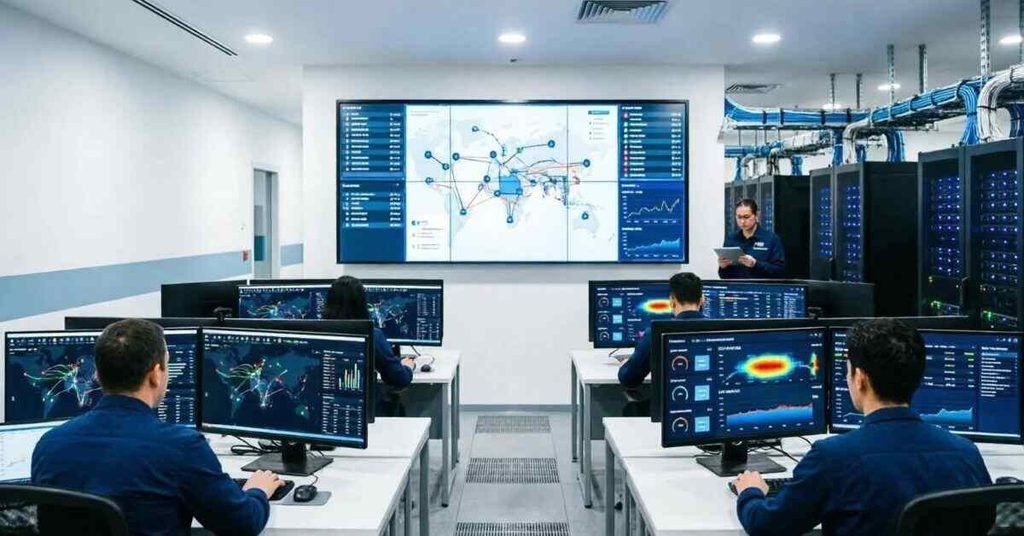
A practical architecture has six major components.
1. Telemetry collection: Network devices, wireless access points, firewalls, cloud services, and monitoring platforms produce logs, metrics, events, and flow records.
2. Data normalization: The system standardizes timestamps, device identities, event formats, and relevant network identifiers. Without this step, the model may receive conflicting or incomplete evidence.
3. Context and retrieval: A retrieval system can provide approved configuration templates, network diagrams, runbooks, vendor documentation, and historical incident records to help ground the response.
4. AI reasoning and interpretation: A language model interprets the operator’s question, summarizes evidence, identifies possible causes, and proposes next steps. Its output should be checked against authoritative telemetry and deterministic tools.
5. Policy and execution layer: Automation services validate proposed actions against access permissions, configuration rules, change windows, and approval requirements before execution.
6. Verification and audit: Monitoring systems confirm whether the change achieved its intended result. The platform records the request, evidence, approvals, executed commands, and outcome.
The separation between reasoning and execution is essential. A model can generate a plausible explanation that is technically wrong, so it should not have unrestricted access to production equipment.
Vendor Examples: Cisco, Juniper, AWS, and NVIDIA
Several technology providers address different parts of this architecture.
- Cisco: Cisco AI Assistant and its agentic network operations initiatives support natural-language interaction, network troubleshooting, and supervised workflows for selected operational tasks. See the Cisco AI Assistant overview for the vendor’s published capabilities.
- Juniper Networks: Juniper Mist combines AI-driven network insights and automation across supported enterprise networking products. Its value depends on the deployed product portfolio, available telemetry, and integration requirements.
- Amazon Web Services (AWS): AWS provides cloud infrastructure and managed AI services that organizations can use to build internal network operations assistants, subject to service availability, permissions, and regional requirements.
- NVIDIA: NVIDIA supplies accelerated computing platforms used to train and run AI models. In networking environments, these capabilities can support AI infrastructure and related workloads, rather than replacing the switching, routing, and control-plane functions of a network.
These examples are not interchangeable products. A network operations team should evaluate each platform according to its actual capabilities, supported integrations, licensing model, data handling, and execution controls.
A Practical Network Troubleshooting Workflow
Consider a retail company whose employees experience intermittent application delays at several branches. A conventional workflow might require separate investigations into wireless performance, WAN latency, DNS behavior, firewall events, and application health.
An AI-assisted workflow can organize this investigation into a consistent sequence:
- Identify the scope: Determine which branches, applications, users, and time periods are affected.
- Collect evidence: Retrieve relevant interface statistics, wireless client events, latency measurements, routing changes, and application telemetry.
- Correlate events: Compare timestamps and network paths to identify common symptoms or a shared dependency.
- Generate hypotheses: Ask the model to rank possible causes and identify missing evidence.
- Validate the leading hypothesis: Use direct measurements and deterministic diagnostic tools rather than relying on the generated explanation alone.
- Propose a correction: Prepare a narrowly scoped change, such as adjusting a supported policy or correcting an erroneous configuration.
- Approve and execute: Apply the change through an authorized automation system, with human approval where required.
- Verify the outcome: Compare latency, error rates, and application performance before and after the change.
This process can reduce repetitive investigation and improve consistency. It does not guarantee faster resolution in every incident, particularly when telemetry is missing or the fault lies outside the organization’s visibility.
3. How Robotics and Intelligent Networking Connect
At first glance, a robotic arm and an enterprise router appear to solve unrelated problems. One manipulates physical objects; the other forwards packets between network endpoints.
Yet both systems depend on observations, decisions, actions, and feedback. Their shared architecture helps explain why AI techniques developed in one domain can inform work in the other.
A Shared Perception-to-Action Model
1. Observe
Robot sensors or network telemetry
2. Interpret
Computer vision, analytics, or AI-assisted reasoning
3. Plan and validate
Motion planning or network policy checks
4. Execute and verify
Controlled robot movement or authorized network changes
The critical difference lies in timing and consequences. A robotic control loop may need to respond within milliseconds to prevent a collision or maintain balance. Enterprise troubleshooting often permits more time for investigation, approval, and staged deployment.
That difference determines where a generative model belongs. A large language model should not be inserted into a time-critical motor-control loop simply because it can interpret instructions. Likewise, a network model should not independently rewrite routing policies without considering convergence, redundancy, and failure recovery.
The Role of Edge Computing and Connectivity
AI-enabled robots often depend on reliable communication with local servers, manufacturing systems, or cloud services. Poor wireless coverage, congestion, and packet loss can interrupt coordination or delay noncritical instructions.
For latency-sensitive behavior, the preferred design is usually to keep essential control functions close to the equipment. Local inference can handle time-sensitive perception, while centralized infrastructure manages model updates, fleet analytics, historical analysis, and broader optimization.
In an industrial environment, an autonomous mobile robot might use local obstacle avoidance while communicating inventory status to a warehouse management system. The network supports coordination, but loss of connectivity should not disable essential safety behavior.
This is where edge computing, network segmentation, quality of service (QoS), and resilient wireless design become important. Teams should define which functions can tolerate delay, which must continue offline, and which require an immediate safe-state response.
A Connected Factory Example
Imagine a factory using AI-assisted inspection robots across several production lines. Each robot collects visual information and sends inspection results to an industrial application.
An enterprise networking assistant could correlate inspection delays with wireless roaming events, congestion, or upstream application response times. It could recommend a network change, while the robotics platform separately evaluates whether inspection performance has returned to normal.
The result is a coordinated operational workflow in which robotics and networking systems exchange verified information without handing unrestricted control to a single AI model.
4. Implementation Strategy: From Pilot to Production
An enterprise should not begin by giving an AI assistant permission to change every router or robot. A safer approach is to identify one measurable operational problem, test the technology against real conditions, and expand only after the results meet defined acceptance criteria.
Step 1: Select a Specific Business Problem
For robotics, a suitable starting point might be visual inspection of a repetitive assembly task, package identification, or inventory movement in a controlled area.
For networking, start with incident summarization, configuration documentation, recurring connectivity investigations, or assistance with approved diagnostic commands.
Define the baseline before deployment. Record the current error rate, technician workload, task completion time, incident frequency, and operational cost as applicable.
Step 2: Assess Data Quality and Integration
Robotics projects require representative sensor data, accurate equipment models, and access to relevant control interfaces. Networking projects need consistent telemetry, reliable device inventories, current topology information, and access to approved configuration records.
Check for missing timestamps, inconsistent device names, stale documentation, and blind spots in monitoring. A sophisticated model cannot reliably compensate for incomplete or contradictory operational evidence.
Step 3: Build a Controlled Test Environment
For robotics, use simulation, recorded sensor data, test fixtures, and restricted physical trials. Validate unexpected objects, lighting changes, mechanical limitations, and recovery behavior.
For networking, use a lab, configuration snapshots, a digital twin where appropriate, or a staging environment that resembles the production topology. Test proposed changes against known failure cases before authorizing production execution.
Step 4: Introduce Human Approval
Begin with read-only assistance. Let the AI explain an incident or generate a proposed configuration without executing it.
Next, allow narrowly scoped actions that require explicit approval. Only consider limited automatic remediation after the team has demonstrated reliable outcomes, effective rollback, and adequate monitoring.
Step 5: Establish Continuous Evaluation
Track false diagnoses, unsuccessful actions, model changes, and unexpected behavior. Revalidate the system after updates to the model, network platform, robot firmware, or surrounding infrastructure.
AI performance can deteriorate when conditions change, even when the model itself has not been modified. Production deployment therefore requires ongoing testing, not a one-time acceptance test.
5. Performance Metrics, Bottlenecks, and ROI
The financial case for AI depends on measurable improvements rather than impressive demonstrations. Robotics teams must consider throughput and physical safety, while networking teams should measure service reliability, diagnostic effort, and the risk associated with automated changes.
Key Performance Metrics
The following figures are illustrative pilot targets, not industry benchmarks or guaranteed results. Actual targets should be established from a site’s baseline, workload, and risk tolerance.
| Metric | AI in Robotics | Generative AI in Networking |
|---|---|---|
| Primary performance measure | Successful task completion | Successful incident diagnosis and resolution |
| Speed | Cycle time per task | Mean time to resolution (MTTR) |
| Quality | Defect detection and false-rejection rate | Diagnostic accuracy and false recommendations |
| Reliability | Failed tasks and recovery frequency | Change failure rate and service availability |
| Safety | Safety incidents and limit violations | Unauthorized changes and policy violations |
| Efficiency | Labor hours per completed task | Engineer hours per incident |
| Suggested pilot target | Improve task time by 10% without reducing quality | Reduce median diagnostic time by 15% without increasing change failures |
The proposed improvements are evaluation goals only. Neither target should be accepted if the system increases safety incidents, causes service degradation, or shifts costs elsewhere.
Latency and Reliability
Latency must be evaluated according to the function being performed. A robot’s low-level movement controller has different timing requirements from a model that summarizes a shift report.
Similarly, a network assistant can take several seconds to prepare an incident explanation, but packet forwarding, routing convergence, and other real-time network functions must continue independently of that response.
Measure p50, p95, and p99 latency where appropriate, along with timeout rates, task success, error rates, and system availability. Tail latency is especially important because occasional slow responses can disrupt otherwise reliable automation.
Implementation Bottlenecks
Four challenges commonly determine whether a project succeeds.
- Data quality: Missing or misleading observations undermine model output and root-cause analysis.
- Legacy integration: Older industrial controllers and network devices may expose limited APIs or use proprietary management interfaces.
- Operational trust: Engineers may reject a system that cannot explain its recommendations or consistently produces incorrect results.
- Inference and infrastructure costs: Model hosting, GPU capacity, telemetry retention, licensing, integration work, and support can outweigh the savings from a small pilot.
A further issue is model drift. Changes in production materials, wireless environments, software versions, and traffic patterns can reduce performance unless evaluation datasets and operational thresholds are maintained.
Calculating Return on Investment
Use a total-cost-of-ownership model rather than comparing only model inference costs with projected labor savings.
A simple calculation is:
\[ \text{Net Annual Benefit} = \text{Annual Savings} – \text{Annual Operating Costs} \]
\[ \text{ROI} = \frac{\text{Annual Savings} – \text{Annual Costs}} {\text{Initial Investment}} \times 100\% \]
Include hardware, integration, training, security reviews, maintenance, licensing, downtime risk, and employee oversight. For robotics, account for tooling, safety validation, and production-line modifications; for networking, include platform integration, change management, and incident recovery.
For example, suppose a networking pilot saves an estimated $60,000 per year in labor and operational overhead, costs $20,000 annually to operate, and requires an initial investment of $50,000. Its illustrative first-year net benefit after operating costs and initial investment would be negative $10,000, while its annual operating benefit would be $40,000.
This distinction matters because a project can have positive recurring savings without recovering its initial investment during the first year.
6. Technical Comparison: Traditional vs. AI-Assisted Systems
The following table summarizes common architectural differences. Actual capabilities depend on the specific equipment, software, and deployment model.
| Capability | Traditional Approach | AI-Assisted Approach |
|---|---|---|
| Robot perception | Fixed rules and programmed inspection | Vision models and learned perception |
| Robot task planning | Predetermined sequences | Adaptive planning with validated constraints |
| Network troubleshooting | Manual investigation across dashboards | AI-assisted correlation and explanation |
| Configuration work | Templates and manually written changes | Generated proposals validated by policy engines |
| Handling unusual conditions | Escalation or predefined fallback | Potentially better interpretation, subject to testing |
| Operational control | Explicit programmed logic | Hybrid control with AI suggestions and deterministic safeguards |
| Data requirements | Rules, configurations, and relevant measurements | Those same inputs plus suitable evaluation data and model context |
| Main risk | Limited flexibility and manual effort | Incorrect output, overautomation, and added complexity |
The strongest architecture is often hybrid. Deterministic software handles functions requiring predictable behavior, while AI assists with perception, interpretation, planning, and operator workflows.
For enterprise networking, configuration validation and routing protocols should remain authoritative. For robotics, safety-rated systems, motion constraints, and emergency-stop mechanisms must retain their independent roles.
Choosing the Right Deployment Model
Organizations can run AI services in the cloud, in their own data centers, or at the edge.
Cloud deployment can simplify access to managed models and scalable computing, but it introduces connectivity dependencies, data-transfer considerations, and potentially variable latency.
On-premises deployment offers greater control over infrastructure and data residency, but requires capacity planning, patching, model serving, and operational expertise.
Edge deployment places inference closer to equipment, which can reduce communication delay and support selected offline functions. However, edge devices have constrained compute resources and require careful lifecycle management.
The right choice depends on latency, privacy, reliability, budget, and integration requirements not on the assumption that one deployment model is always superior.
Technical Note & Security Considerations
Security must be designed into the architecture before AI receives operational permissions.
- Apply Zero Trust Principles: Authenticate users and services, verify each request, and grant only the minimum permissions needed. Protect sensitive data by removing unnecessary personal information, credentials, customer records, and confidential configuration details from model inputs. Review data retention, regional processing, and provider access policies.
- Defend Against Prompt Injection: Treat retrieved documents, logs, device banners, and external content as untrusted input. Never let text inside those sources override security policies or grant permissions.
- Validate Every Proposed Change: Use schema checks, configuration parsers, policy rules, topology validation, and controlled testing before execution.
- Maintain Auditability: Record prompts, evidence sources, approvals, model versions, commands, and outcomes while protecting sensitive log content.
- Enforce Physical Safety: In robotics, preserve independent emergency stops, interlocks, protective zones, and validated motion limits. Do not depend on a generative model for emergency control.
- Plan for Failure: Establish rollback procedures, safe fallback behavior, rate limits, and a manual operating mode for outages or incorrect model output.
Security warning: A model-generated explanation is not proof of a root cause, and a plausible configuration is not necessarily a safe configuration. Production changes should pass through deterministic controls and authorized operational workflows.
Conclusion
AI in Robotics and generative AI in enterprise networking are advancing two important areas of enterprise technology: physical automation and intelligent infrastructure management. Robotics systems can use AI to interpret sensor data, adapt task plans, and improve inspection workflows, while networking platforms can help engineers investigate incidents, understand complex telemetry, and prepare controlled configuration changes.
In 2026, the strongest implementations are not necessarily those with the highest degree of autonomy. They are the ones that solve clearly defined problems, demonstrate measurable improvements, and maintain appropriate safeguards. NVIDIA’s robotics development ecosystem illustrates the growing role of simulation and synthetic data in physical AI, while Cisco’s AI networking initiatives demonstrate how generative AI and supervised workflows can support network operations.
Final Thoughts
For technology leaders, the next step is to identify a suitable pilot, establish baseline performance, validate the system in a controlled environment, and calculate its full operating cost. Teams should expand automation only when the evidence supports doing so.
The future will likely bring closer coordination between intelligent machines, edge computing, and AI-assisted networks. Organizations that combine these capabilities with sound engineering, robust security, and skilled human oversight will be better prepared to adopt new technology responsibly.
At Tech Sprinto, our goal is to help readers understand these developments through practical technical analysis, clear explanations, and actionable guidance for modern enterprise environments.
AI in Robotics combines machine learning, computer vision, planning, and control software to help robots perceive their surroundings and perform tasks. Depending on the application, AI may support object recognition, navigation, inspection, manipulation, or adaptive task planning.
Generative AI can summarize network incidents, interpret telemetry, explain configurations, retrieve troubleshooting procedures, and propose remediation steps. Production changes should be validated through approved automation systems rather than executed solely on the model’s recommendation.
Yes, selected problems can be addressed through AI-assisted automation when the platform has suitable integrations and explicitly authorized permissions. Effective implementations validate the diagnosis, restrict the available actions, verify the outcome, and provide a rollback path.
AI in Robotics interprets physical environments and helps machines perform tasks involving movement or interaction with objects. Network AI focuses on connectivity, telemetry, configuration, performance, and service reliability, although both can use machine learning, inference, planning, and feedback.
NVIDIA offers robotics development and simulation technologies, while Cisco provides AI-assisted networking capabilities. Juniper Networks and AWS also offer technologies relevant to AI-driven network operations and infrastructure, although their roles and features vary by product and deployment.

1 thought on “AI in Robotics & Generative AI in Networking in 2026”