
Enterprise networks are being asked to do more than connect employees, servers, and applications. What is Network Architecture They must support hybrid work, distributed cloud platforms, real-time analytics, cybersecurity controls, and increasingly demanding artificial intelligence workloads without compromising availability or performance.
For infrastructure leaders, the challenge is not simply adding bandwidth. It is managing a growing number of interconnected systems while maintaining visibility, controlling operational costs, and responding to problems before they affect business services.
This is where network architecture and generative AI in enterprise networking intersect. A well-designed architecture establishes how traffic moves, how services communicate, where security controls operate, and how the organization can expand without introducing unnecessary complexity. Generative AI adds a new operational layer that can interpret telemetry, explain configuration problems, assist engineers with troubleshooting, and help translate business requirements into technical actions.
In 2026, this combination matters because AI is changing both sides of the networking equation. Enterprises are using AI to operate their networks, while AI applications themselves demand specialized connectivity between compute nodes, storage systems, cloud environments, and distributed users. NVIDIA’s Spectrum-X platform, for example, targets the high-bandwidth, predictable performance requirements of large-scale AI infrastructure. NVIDIA’s platform overview describes its focus on AI data-center networking and performance isolation.
This article explains what network architecture is, how its major components work, and where generative AI can improve enterprise operations. It also examines vendor approaches, practical implementation steps, performance metrics, financial trade-offs, and the security controls organizations need before allowing AI systems to influence production infrastructure.
1. What Is Network Architecture?
Network architecture is the structured design of a network’s components, communication paths, protocols, security boundaries, and management systems. It defines how devices connect, how data travels between endpoints, and how the infrastructure supports business applications under normal conditions and during failures.
A network architecture is more than a diagram showing routers and switches. It is a set of technical decisions about capacity, redundancy, routing, segmentation, access control, observability, and operational responsibility.
For example, a company operating several offices, a private data center, and workloads in AWS needs an architecture that connects those environments reliably. It must also determine which traffic can communicate across locations, how remote employees authenticate, and what happens if a cloud connection or WAN circuit becomes unavailable.
Core Components of Enterprise Network Architecture
A typical enterprise environment contains several interconnected layers.
- Access layer: Connects endpoints such as laptops, wireless clients, printers, phones, and IoT devices.
- Distribution and core layers: Aggregate traffic, enforce routing policies, and provide resilient paths between network segments. Some modern campus designs combine these functions.
- Data-center fabric: Connects servers, storage, virtualization platforms, and AI compute systems, often using leaf-spine topologies.
- Wide-area networking: Connects branches, headquarters, data centers, remote users, and cloud environments through private links, internet connectivity, SD-WAN, or combinations of these.
- Security architecture: Applies identity verification, firewalls, segmentation, access policies, encryption, and threat monitoring.
- Management and observability: Collects logs, configuration state, flow records, events, and performance measurements for troubleshooting and operational control.
These components must work as a coherent system. A fast switching fabric cannot compensate for a poorly configured firewall, and a resilient WAN does not guarantee a reliable application if its DNS, identity, or cloud dependencies fail.
Common Network Architecture Models
Traditional three-tier architecture separates access, distribution, and core functions. It remains useful in many campus networks because it supports hierarchical management and clear operational boundaries.
Leaf-spine architecture is common in modern data centers. Each leaf switch connects to spine switches, providing multiple paths and more predictable east-west traffic movement as workloads communicate across racks.
Software-defined networking (SDN) separates logical network control from individual forwarding devices to varying degrees. Centralized controllers and policy-driven management can simplify provisioning, although the implementation details differ across vendors.
Cloud and hybrid architecture connects on-premises systems to public-cloud networks, virtual networks, private connectivity services, and software-defined security controls. Its design must account for routing boundaries, identity, latency, and data-transfer costs.
Zero Trust architecture treats access decisions as resource-specific rather than assuming that a device is trustworthy because it sits inside a corporate network. NIST SP 800-207 provides a formal foundation for this approach. NIST Zero Trust Architecture.
The right model depends on application requirements, existing equipment, regulatory obligations, traffic patterns, and the organization’s ability to operate the resulting environment.
Why Network Architecture Matters in 2026
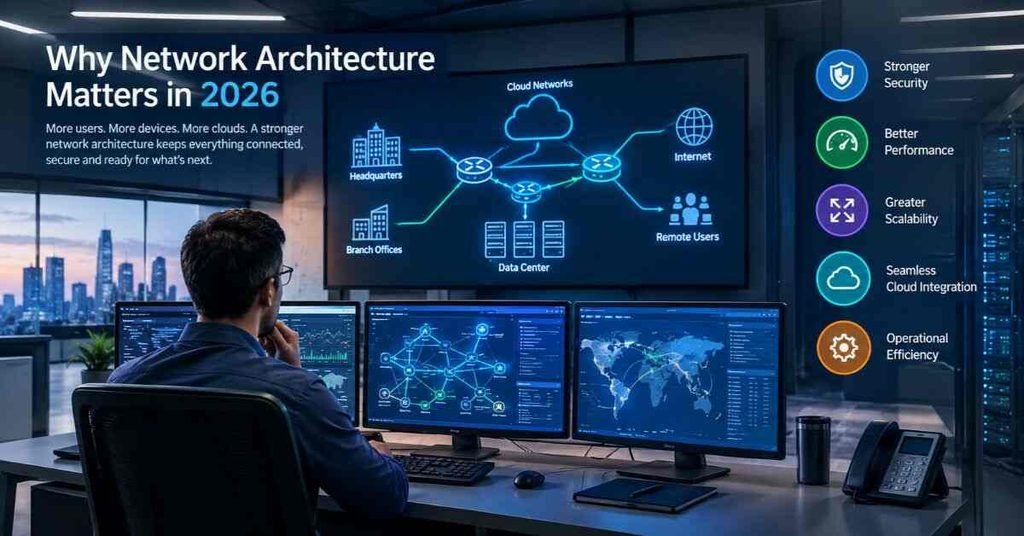
Enterprise infrastructure is increasingly distributed across physical sites, public clouds, SaaS platforms, remote endpoints, and AI systems. Each additional environment introduces dependencies that can complicate routing, monitoring, troubleshooting, and security enforcement.
A modern architecture makes those dependencies explicit. It establishes consistent policy boundaries, defines acceptable performance, and gives operations teams a foundation for automation.
It also determines how effectively AI tools can assist the network team. If device configurations are undocumented, telemetry is incomplete, and each location follows different standards, an AI assistant will have difficulty producing reliable recommendations.
Good architecture therefore remains the prerequisite for useful AI operations, not something generative AI can replace.
2. How Generative AI Is Transforming Enterprise Networking
Generative AI uses models trained to produce and interpret content, including natural language, code, structured outputs, and technical explanations. In networking, these capabilities can provide a conversational interface to operational data and help engineers move from raw alerts to actionable hypotheses.
Traditional network automation usually follows predefined rules. A script might detect a failed interface and execute a specific command, while an AI-assisted system may correlate the interface event with routing changes, application latency, and earlier incidents to suggest possible causes.
That difference is valuable, but it requires careful interpretation. Generative AI can assist diagnosis and decision-making; it does not automatically guarantee correct root-cause analysis or safe remediation.
AI-Assisted Troubleshooting and Root-Cause Analysis
Network teams often receive multiple alerts from the same underlying fault. A failed upstream link can trigger routing changes, packet loss, application timeouts, and monitoring alarms across several systems.
An AI-assisted workflow can correlate these signals and present an explanation in plain language. Instead of manually reviewing dozens of separate events, an engineer might ask, “Why did users in the Lahore office experience slow access to the finance application?”
A properly integrated assistant could examine WAN utilization, packet-loss measurements, route changes, DNS responses, firewall events, and application telemetry. It could then rank plausible causes and identify the evidence supporting each one.
The result depends on the quality of the data and integrations. Missing telemetry, incorrect timestamps, incomplete topology information, or misleading alerts can produce a confident but inaccurate explanation.
Natural-Language Network Operations
Generative AI also makes network information easier to query without requiring every user to memorize vendor-specific commands.
An engineer could request a summary of overloaded interfaces, ask which access points have recurring client failures, or request a comparison between the intended configuration and the current device state.
Products such as HPE Juniper Networks’ Marvis AI Assistant use conversational AI capabilities for network operations across supported wired, wireless, and WAN environments. Juniper describes capabilities that include proactive insights, operational assistance, and network troubleshooting. Marvis AI Assistant.
These tools can reduce the effort required to locate information, but their usefulness depends on which devices, applications, and telemetry sources the platform can actually access.
Configuration Generation and Change Planning
AI models can help draft configuration templates, explain routing policies, translate requirements into structured rules, and identify differences between intended and deployed settings.
Consider an enterprise opening a new branch. An engineer might describe the required VLANs, addressing scheme, wireless access policies, routing behavior, and management requirements in natural language.
An AI assistant could turn that request into a proposed implementation plan, configuration snippets, and validation checks. The engineer would then review the output, test it against the target platform, and approve the change through the organization’s established workflow.
Configuration generation is not the same as configuration validation. A syntactically correct command can still create an unintended route, expose a sensitive subnet, disrupt a redundant path, or conflict with an existing policy.
The safest approach is to use AI for drafting and review, then rely on deterministic validation, change approval, and controlled deployment.
Predictive Operations and Incident Prevention
Machine-learning systems have long been used to identify anomalies in network behavior. Generative AI can make the findings easier to interpret by summarizing trends and connecting observations to operational context.
For example, an AI-assisted system may highlight a branch circuit whose utilization repeatedly approaches its configured capacity during business hours. It could explain the likely impact, compare recent measurements with historical patterns, and recommend checking application traffic or capacity requirements.
This is different from guaranteeing that a failure will be predicted. Forecasts remain sensitive to changing traffic, seasonal demand, incomplete data, and unexpected application behavior.
The most reliable operational model combines statistical anomaly detection, established alerting thresholds, and AI-generated explanations rather than replacing existing monitoring with a language model.
3. The Technical Architecture Behind AI-Driven Networking
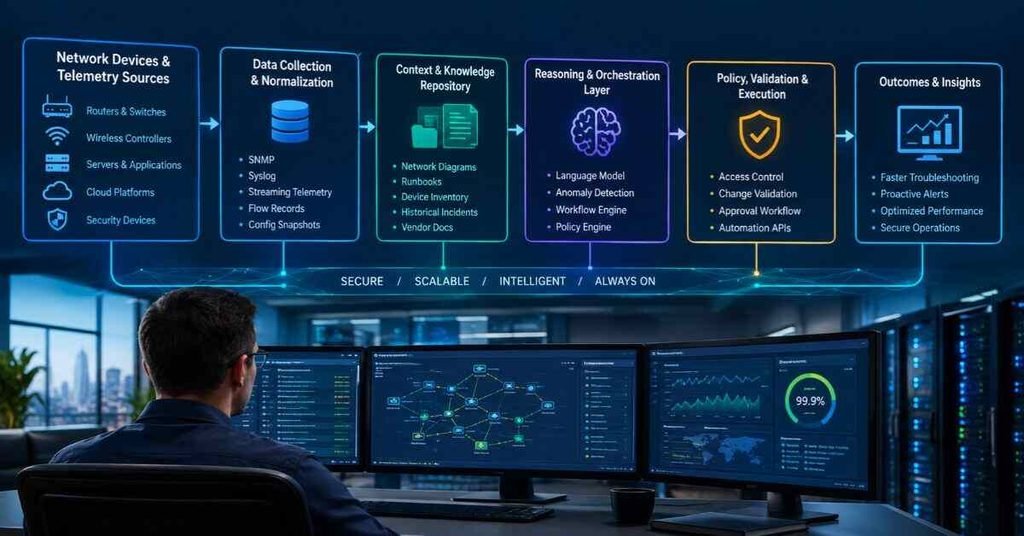
A production-grade AI networking system needs more than a chatbot connected to a router. It requires a controlled pipeline between network devices, telemetry systems, an AI inference service, policy enforcement, and the engineer or automation platform responsible for taking action.
A practical design separates data collection, reasoning, policy enforcement, and execution. This reduces the risk of allowing an AI model to operate as an unrestricted administrator.
Telemetry and Data Collection Layer
The foundation is a consistent view of the network’s actual condition. Relevant data can include SNMP metrics, streaming telemetry, flow records, syslog messages, routing events, wireless client statistics, configuration snapshots, and application performance measurements.
Organizations should normalize timestamps, device identities, site identifiers, and event formats where possible. They should also distinguish between the intended configuration and the configuration actually running on each device.
Telemetry retention and access controls matter because network logs can contain sensitive internal addresses, usernames, device identifiers, and security events. Data collection should follow a defined purpose and retention policy.
Context and Retrieval Layer
A generative AI model needs relevant technical context to answer questions accurately. That context may include approved network diagrams, device inventories, configuration standards, runbooks, incident histories, and vendor documentation.
Retrieval-augmented generation (RAG) allows an application to retrieve relevant documents or records and supply them to the model during a request. In a networking environment, this can help an assistant answer questions using current internal procedures rather than relying entirely on its general training.
The retrieval system must enforce permissions. An engineer authorized to manage a branch network should not automatically gain access to sensitive data-center configurations simply because both are indexed by the same AI platform.
Reasoning and Orchestration Layer
The AI layer interprets the request, selects relevant evidence, and proposes an explanation or action. Depending on the system, it may use a large language model, specialized anomaly-detection models, workflow engines, or a combination of these technologies.
A useful design separates the model’s proposed action from the system that executes it. For instance, the model may recommend checking a BGP neighbor or generating a candidate access-control change, while a deterministic controller verifies the target, permissions, and policy constraints.
Structured tool calls and explicit schemas are preferable to allowing the model to generate arbitrary commands and execute them directly.
Policy, Approval, and Execution Layer
This layer converts a recommendation into a controlled operational action. It should verify the requested operation, target device, permitted scope, expected outcome, and rollback procedure.
Low-risk actions, such as retrieving interface statistics, may be fully automated under an approved policy. High-impact changes, such as modifying routing, altering firewall rules, or changing production segmentation, should require stronger validation and human authorization.
A robust workflow records the request, retrieved evidence, model output, policy decision, approved change, execution result, and rollback status. This audit trail is essential when a change affects business-critical services.
Reference Architecture Table
| Architecture layer | Primary responsibility | Example technologies or methods | Main operational risk |
| Network infrastructure | Forward traffic and enforce device-level policies | Cisco switching and routing, Juniper networking, firewalls | Hardware failure or misconfiguration |
| Telemetry and monitoring | Collect performance and event data | SNMP, streaming telemetry, syslog, flow records | Missing or inaccurate observations |
| Context and retrieval | Supply trusted network knowledge | Configuration repositories, runbooks, RAG | Stale documents or excessive data access |
| AI reasoning | Interpret requests and propose actions | LLMs, anomaly detection, workflow orchestration | Hallucinations or incorrect recommendations |
| Policy and validation | Check safety and authorization | RBAC, schema validation, policy-as-code | Incomplete enforcement rules |
| Execution and audit | Apply approved changes and record outcomes | Network APIs, controllers, change management | Service disruption or failed rollback |
The key architectural principle is that the AI model should not become the sole source of truth. Device state, validated policies, telemetry, and controlled execution systems must remain authoritative.
4. Enterprise Use Cases, Vendor Examples, and Deployment Workflows
The practical value of generative AI becomes clearer when it is tied to a specific operational problem. Different network domains require different integrations, and a successful pilot should target a measurable source of engineering effort or service disruption.
Campus Networks and Wireless Operations
Large campuses can generate thousands of client connectivity events, authentication failures, roaming issues, and access-point alerts. Correlating those events across buildings and network segments can consume substantial engineering time.
An AI assistant can help identify recurring client failures, summarize wireless experience by location, and guide troubleshooting through authentication, DHCP, DNS, and radio-performance checks.
HPE Juniper Networking’s Mist platform and Marvis assistant illustrate how AI-native operations can span supported wireless, wired, and WAN services. Juniper Mist AI.
The deployment trade-off is platform coverage. An assistant may have deeper visibility into its own vendor’s devices than into third-party equipment, so enterprises should test mixed-vendor workflows before committing to a broad rollout.
Data Centers and AI Compute Fabrics
AI training and distributed inference can produce intensive traffic between GPUs, storage systems, and servers. Congestion, inefficient routing, or inconsistent performance can reduce accelerator utilization even when expensive compute hardware is available.
NVIDIA’s Spectrum-X Ethernet platform is designed for AI data-center networking, combining compatible switching and network-interface technologies to improve effective bandwidth and performance consistency for large-scale workloads. NVIDIA publishes a claimed 1.6× networking performance improvement relative to off-the-shelf Ethernet for its platform; this is a vendor-reported result, not a universal benchmark for every environment. NVIDIA Spectrum-X.
Generative AI helps the operational side by summarizing telemetry, interpreting congestion events, and assisting engineers with configuration analysis. It does not eliminate the need for sound fabric design, workload-aware capacity planning, congestion control, or application-level testing.
Hybrid Cloud and Multi-Cloud Connectivity
Enterprises running applications across on-premises infrastructure and cloud providers must manage route propagation, IP address overlap, firewall policy, identity, and data-transfer charges.
An AI assistant can explain connectivity dependencies, summarize route-table changes, and help compare a proposed design with documented architecture standards. Cloud networking APIs and infrastructure-as-code pipelines can provide the structured interfaces needed for validation.
AWS environments, for example, can be managed through established cloud networking services and APIs. The exact automation options depend on the service, account permissions, deployment model, and regional configuration.
AI-generated recommendations should be checked against actual cloud route tables, security groups, network access controls, and cost implications. A theoretically shorter network path may not be the least expensive or most compliant option.
A Step-by-Step Enterprise Implementation Plan
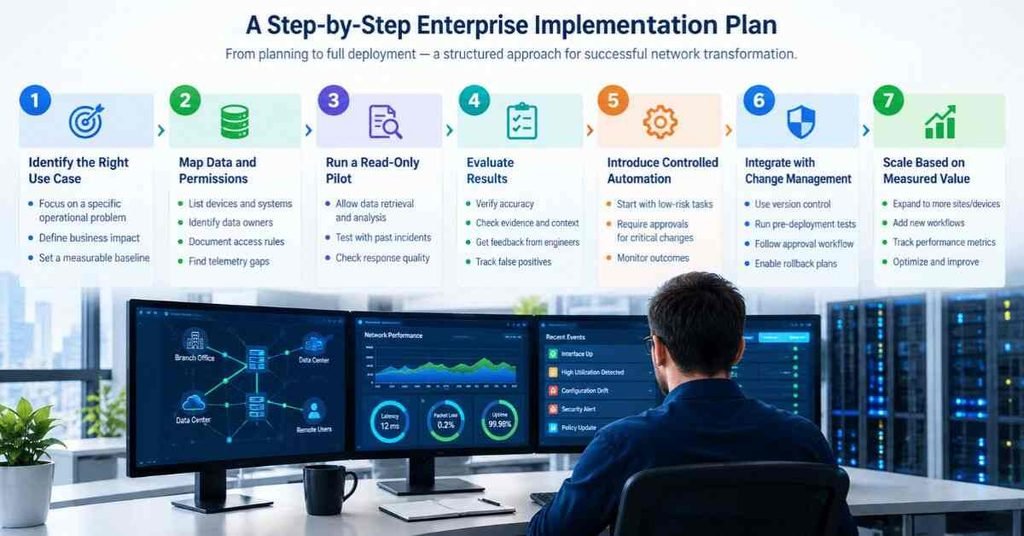
Step 1: Select a narrow operational problem. Start with a recurring issue such as wireless troubleshooting, WAN incident triage, configuration drift, or ticket summarization. Define the business impact and establish a baseline before introducing AI.
Step 2: Map the data and permissions. Identify which devices, monitoring systems, configuration repositories, and incident tools the assistant will access. Document data owners, access restrictions, retention rules, and gaps in telemetry.
Step 3: Establish a read-only pilot. Allow the system to retrieve evidence and propose explanations without changing production configuration. Test it against historical incidents and known failure scenarios.
Step 4: Evaluate answer quality. Ask experienced engineers to judge whether recommendations are factually correct, supported by evidence, relevant to the incident, and safe to follow. Track false explanations as well as successful diagnoses.
Step 5: Introduce controlled automation. Begin with low-risk actions such as collecting diagnostic data or opening a structured incident ticket. Require approvals for changes that could affect availability, security, or routing.
Step 6: Integrate with change management. Connect approved actions to version control, automated testing, maintenance windows, change records, and rollback procedures. Preserve the ability to stop or disable the automation independently of the AI service.
Step 7: Expand based on measured results. Add more sites, devices, and workflows only when the initial deployment demonstrates reliable performance and a defensible business benefit.
This staged method is more practical than deploying a general-purpose AI agent across the entire network before its access boundaries and failure modes are understood.
5. Performance Metrics, Implementation Bottlenecks, and Cost/ROI
Enterprise networking projects should be judged by operational results, not by how impressive a demonstration appears. A natural-language interface may be convenient, but it has limited value if engineers still need to repeat every diagnostic step manually.
Metrics That Matter
Organizations should measure network performance and AI-assisted operational performance separately.
Network metrics include latency, jitter, packet loss, throughput, link utilization, availability, and application response time. For AI workloads, teams may also measure effective bandwidth, GPU utilization, job completion time, and the impact of communication bottlenecks.
Operational metrics should include mean time to detect (MTTD), mean time to resolve (MTTR), time spent on routine tickets, percentage of recommendations accepted by engineers, false-positive rate, and the frequency of AI-generated suggestions that require correction.
An example pilot might target a 15% reduction in median incident-triage time over a defined evaluation period. That is an illustrative target, not a guaranteed result; the organization should choose a target appropriate to its baseline and incident mix.
Latency and Reliability Bottlenecks
AI assistance introduces its own dependencies. A request may require telemetry collection, data retrieval, model inference, approval, and a separate device-management call.
The total response time depends on each stage. If the assistant is used for human-guided troubleshooting, a delay of several seconds may be acceptable; if it participates in a time-sensitive control loop, external model latency and unpredictable responses may make it unsuitable.
Fast, safety-critical functions should generally remain in deterministic network control systems. Generative AI is better positioned to support diagnosis, planning, policy interpretation, and carefully bounded operational tasks.
Cost and Return on Investment
The total cost of ownership includes AI service usage, infrastructure, vendor licensing, telemetry storage, integration engineering, security reviews, training, and ongoing model evaluation.
Potential savings include reduced troubleshooting effort, fewer repetitive support tasks, faster incident handling, better capacity planning, and lower downtime exposure. Those benefits should be measured rather than assumed.
A basic annual ROI model is:
Net annual benefit = measured annual savings − annual operating and support costs
ROI (%) = (net annual benefit ÷ total annual investment) × 100
For example, suppose a pilot saves 400 engineering hours annually at a fully loaded labor cost of $60 per hour. The gross labor benefit is $24,000 per year; if annual platform, integration, and support costs total $18,000, the direct net benefit is $6,000 before accounting for implementation costs, service improvements, or avoided downtime.
This simple calculation prevents an organization from treating every hour of AI-assisted work as an automatic cash saving. Time released may improve service quality without reducing payroll expenditure.
Legacy Equipment and Integration Challenges
Older devices may expose only limited telemetry or lack modern APIs. Some systems rely on proprietary command-line interfaces, while others have undocumented configurations or inconsistent naming conventions.
AI integration cannot compensate for these limitations by itself. Enterprises may need to standardize templates, improve inventory accuracy, update monitoring, and consolidate configuration management before a reliable assistant can operate across the environment.
Vendor lock-in is another consideration. A platform that works well with one manufacturer’s equipment may provide less detailed information or fewer automation options for competing products. Evaluate supported integrations, export capabilities, API limits, licensing dependencies, and migration options before selecting a long-term platform.
6. Security, Governance, and the Future of AI-Native Networking
Generative AI can improve visibility, but it also creates a new route through which sensitive network information and operational commands may be exposed. The security design must therefore cover the model, its data sources, its tool integrations, and the systems that execute approved changes.
Technical Note & Security Considerations
- Apply least privilege: Give AI services only the permissions needed for their specific tasks. Use separate read-only and change-capable identities.
- Enforce Zero Trust: Authenticate and authorize users, workloads, and devices rather than trusting requests because they originate inside a corporate network. See NIST SP 800-207.
- Protect sensitive telemetry: Redact credentials, secrets, personal information, and unnecessary internal details before data reaches an external model.
- Defend against prompt injection: Treat retrieved documents, tickets, logs, and device output as untrusted input. A malicious instruction embedded in a log must not override system policies.
- Validate every change: Use schema checks, policy rules, pre-deployment tests, approvals, and tested rollback procedures before modifying production infrastructure.
- Maintain auditability: Record relevant evidence, recommendations, approvals, executed changes, and outcomes in accordance with retention and compliance requirements.
- Plan for model failure: Establish timeouts, fallback workflows, kill switches, and manual operating procedures for unavailable or unreliable AI services.
NIST’s AI Risk Management Framework offers a structured way to identify, assess, and manage risks associated with AI systems across their lifecycle. Its guidance emphasizes trustworthy operation, evaluation, security, accountability, and ongoing risk management. NIST AI RMF.
From AI Assistants to Bounded Autonomous Operations
The next stage is likely to involve more systems that can coordinate multiple steps rather than merely answer questions. An AI agent might gather diagnostics, compare evidence, prepare a change request, run a simulation, and submit the proposed fix for approval.
Such workflows can reduce manual coordination, but increasing autonomy also increases the importance of guardrails. Each action needs an explicit scope, a verifiable expected outcome, and a way to recover when the result differs from the plan.
Enterprises should measure autonomy by the actions a system is authorized to perform, not by marketing labels such as “self-driving” or “agentic.” A system that can recommend a fix is operationally different from one that can execute it on hundreds of production devices.
Network Architecture for AI Workloads
AI itself is also changing infrastructure design. Large training jobs and distributed inference systems need high-bandwidth connections, careful congestion management, predictable latency, and efficient access to storage.
NVIDIA’s announcements around Spectrum-XGS in 2025 illustrate the growing interest in connecting distributed data centers into larger AI computing environments. NVIDIA Spectrum-XGS announcement.
For enterprise architects, the lesson is to design around the workload rather than assume every application needs the same network characteristics. Interactive inference, bulk model training, ordinary business applications, and storage replication may require different quality-of-service policies, capacity profiles, and failure-handling strategies.
Future-ready architecture will combine programmable infrastructure, standardized telemetry, strong identity controls, and automation that can be tested independently of the model generating recommendations.
Conclusion
Network architecture and generative AI in enterprise networking are becoming closely connected disciplines, but successful adoption depends on understanding what each contributes. Architecture establishes the paths, policies, capacity, and resilience that business services require, while AI can help engineers interpret operational data and manage complexity more efficiently.
In 2026, the most practical strategy is to start with a measurable problem, such as repeated incident triage or configuration drift, and introduce AI through a read-only pilot. Establish performance baselines, validate recommendations against real network evidence, and expand into controlled automation only when the results justify the additional risk and expense.
Final Thoughts
Enterprises should also invest in consistent telemetry, documented configurations, Zero Trust controls, and auditable change processes. These foundations improve ordinary network operations while making AI-assisted workflows safer and more useful.
The direction is clear: networks will become more programmable, more workload-aware, and increasingly supported by AI-assisted operations. Organizations that combine sound engineering with disciplined governance will be better positioned to capture those benefits without sacrificing reliability.
For readers of Tech Sprinto, the essential takeaway is straightforward: build the right network architecture first, introduce generative AI with clear boundaries, and measure its value through operational evidence rather than promises.
Network architecture is the blueprint that defines how network devices, applications, security controls, and communication paths fit together. It determines how data moves, how access is controlled, and how the network remains reliable as business requirements change.
Generative AI can summarize network events, explain configuration differences, assist with troubleshooting, draft configuration templates, and translate operational questions into structured diagnostic tasks. Its recommendations should be checked against trusted telemetry and established policies before production changes are made.
It can support automated remediation when connected to authorized tools and controlled workflows, but it should not be given unrestricted access to production devices. High-impact changes require validation, approval, logging, and a tested recovery plan.
AIOps commonly uses analytics and machine learning to detect anomalies, correlate events, and identify operational patterns. Generative AI adds capabilities for natural-language interaction, explanation, summarization, and proposed action generation; the two approaches can work together.
Leaf-spine data-center fabrics are widely used for scalable server connectivity, while large AI clusters may require specialized high-bandwidth networking, congestion control, and workload-aware design. The best choice depends on the cluster size, accelerator platform, communication patterns, latency requirements, and budget.
