


Introduction
Starting a web hosting business is a smart online business idea for people who want recurring monthly income. It allows you to sell hosting services to website owners, bloggers, startups, and local businesses.
The best part is that you do not always need a huge budget to begin. Many people start with reseller hosting and grow slowly over time.
In this guide, you will learn how the business works, why it matters, where the opportunities are, and how to build a hosting brand that can actually compete in today’s market.
Starting a Web Hosting Business Overview

Starting a web hosting business means offering server space, website storage, uptime, security, and technical tools to customers who want their websites online. In simple words, you become the service provider that keeps websites running.
This business can be launched in different ways. You can start small with a reseller hosting model, or you can build a more advanced setup using VPS, cloud hosting, or dedicated servers. Your choice depends on budget, skills, and long-term goals.
How Starting a Web Hosting Business Works
A hosting company buys or rents server resources and then sells them to end users. Customers pay monthly or yearly to host their websites, emails, databases, and applications.
There are usually three basic models:
1) Reseller Hosting
This is the easiest way to begin. You buy hosting resources from a bigger provider and sell them under your own brand.
2) VPS or Cloud Hosting
This gives you more control and better performance. It is suitable if you want to serve growing businesses or developers.
3) Fully Managed Hosting
This model is more premium. You offer not only hosting, but also updates, backups, speed optimization, security, and support.
A successful hosting business is not just about servers. It is also about trust, support, uptime, billing, customer service, and smart positioning.
Importance and Benefits of Starting a Web Hosting Business

The demand for websites is still strong. Every business wants an online presence. That creates long-term need for hosting, domain services, SSL, backups, emails, and support.
This makes starting a web hosting business attractive because it can create recurring revenue, not just one-time sales. Once customers are onboard, they often stay for months or years if your service is reliable.
Key Advantages of Starting a Web Hosting Business
One of the biggest advantages is that this business can scale without needing a physical office. You can serve clients from anywhere and automate many tasks like billing, account setup, and renewals.
It also pairs very well with related services like web design, SEO, WordPress maintenance, domain registration, and digital marketing.
Main Benefits
- Recurring monthly income
- Low startup cost if using reseller hosting
- High upsell potential
- Can be run remotely
- Strong demand from businesses and creators
- Can be combined with web design or SEO services
- Scalable business model
- Easy to build long-term client relationships
If you already work in SEO, blogging, or website development, hosting can become a natural extra income stream.
Uses and Applications of Starting a Web Hosting Business
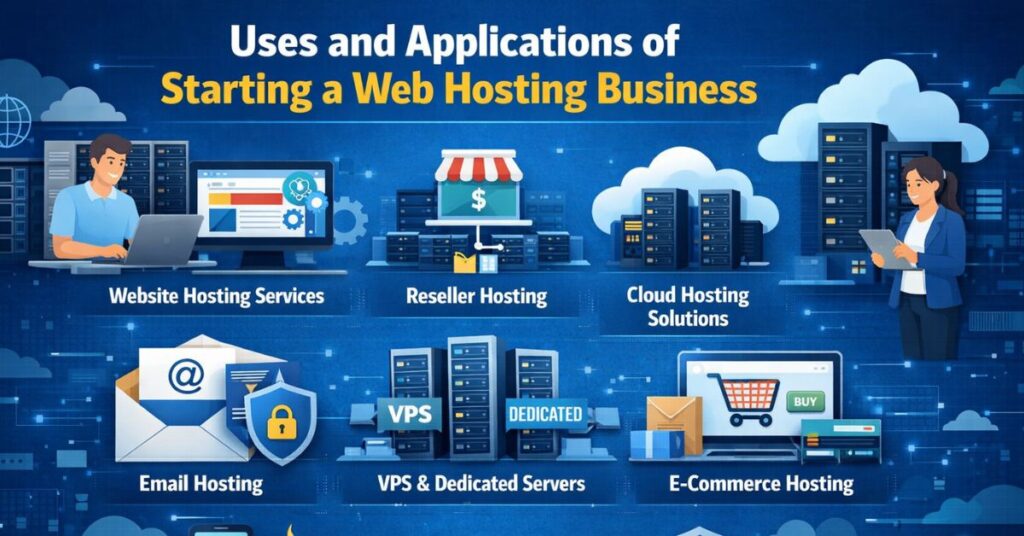
A hosting business is useful in many markets. It is not limited to just bloggers or tech companies. Different industries need hosting for different reasons.
You can build your hosting brand around a specific audience. This is often the smartest strategy because the market is competitive. Instead of trying to serve everyone, you can focus on a niche.
Real Life Examples of Hosting Business Applications
Many successful small hosting brands grow because they solve a specific problem. For example, one business may offer WordPress hosting for bloggers, while another may focus on fast hosting for local businesses.
You can also offer managed hosting for eCommerce stores, agency hosting for web designers, or secure hosting for business websites.
Detailed Table: Hosting Business Use Cases
| Hosting Type | Best For | Main Features | Business Opportunity |
| Reseller Hosting | Beginners | White-label hosting, cPanel, basic support | Easy low-cost entry |
| Shared Hosting | Small websites | Affordable plans, simple setup | Large beginner market |
| WordPress Hosting | Bloggers & businesses | One-click install, caching, backups | High demand niche |
| VPS Hosting | Growing websites | More power, flexibility, control | Better pricing potential |
| Cloud Hosting | Startups & apps | Scalability, uptime, performance | Modern premium service |
| Managed Hosting | Non-technical clients | Maintenance, updates, support | High-value recurring income |
| eCommerce Hosting | Online stores | Speed, SSL, uptime, security | Profitable niche |
| Agency Hosting | Designers & marketers | Multi-site management | Great for service bundling |
This table shows that you do not need to build a giant hosting company. You only need to solve a specific customer need well.
Future Trends of Starting a Web Hosting Business
The hosting market is changing. Basic cheap hosting is still there, but customers now expect more than just storage and bandwidth. They want speed, security, support, automation, and easy management.
In 2026, the strongest hosting opportunities are shifting toward managed services, AI-based automation, performance optimization, and niche-focused hosting offers. Industry reports also show many providers are moving beyond low-cost hosting into higher-value service packages, while customer churn is often driven by price, performance, and missing features.
Future Opportunities in the Hosting Industry
The future is bright for smaller hosting businesses that avoid competing only on price. The real opportunity is in specialization.
To describe our web hosting services, we should say:
- “Fast WordPress hosting for bloggers”
- “Managed hosting for small business websites”
- “Secure hosting for WooCommerce stores”
- “Agency hosting for designers and freelancers”
Key Future Opportunities
- AI-powered hosting dashboards
- Automated backups and malware scans
- Green or eco-friendly hosting
- Niche hosting for specific industries
- Managed WordPress and WooCommerce hosting
- Hosting bundles with SEO or web design
- Faster hosting using edge and CDN tools
This is where new businesses can stand out.
Why Starting a Web Hosting Business Matters Today
Today, almost every serious business needs a website. Even creators, coaches, freelancers, and local stores need online platforms. That means hosting remains a core digital need.
At the same time, many customers feel confused by technical hosting options. They want a provider who makes things simple. That is exactly where a smaller, smarter hosting business can win.
Practical Value for Users
When you start a hosting business, you are not only selling “space on a server.” You are helping customers stay online, stay secure, and grow their online presence.
That creates practical value such as:
- Better website performance
- Easier technical setup
- Faster issue resolution
- Reliable website uptime
- Safer online business operations
In simple terms, you are selling peace of mind, not just hosting plans.
How to Start a Web Hosting Business Step by Step
This is the most important part for beginners. If you want to launch successfully, follow a simple business path instead of overcomplicating things.
Step-by-Step Plan to Launch Your Hosting Business
You do not need to build a huge server company on day one. Start lean and grow with demand.
Step 1: Choose Your Business Model
Decide if you want to start with:
- Reseller hosting
- VPS hosting
- Cloud hosting
- Managed WordPress hosting
For beginners, reseller hosting is usually the easiest.
Step 2: Pick a Niche
Avoid being “just another hosting company.”
Choose a niche like:
- Bloggers
- Small businesses
- Agencies
- eCommerce stores
- Local service businesses
- SEO clients
Step 3: Create Your Hosting Packages
Build simple pricing plans. Keep them easy to understand.
Example:
- Starter Plan
- Business Plan
- Pro Plan
Each should clearly explain storage, bandwidth, email, SSL, backups, and support.
Step 4: Get the Right Tools
You may need:
- WHM/cPanel or control panel
- Billing software
- Domain integration
- SSL setup
- Backup system
- Support ticket system
- Website and landing pages
Step 5: Build Your Brand Website
Your website should include:
- Homepage
- Hosting plans page
- About page
- Contact page
- FAQs
- Terms and privacy pages
- Blog for SEO traffic
Step 6: Set Up Support
Support is a huge part of this business. Fast replies can help you keep customers longer.
Step 7: Start Marketing
Promote through:
- SEO
- Content marketing
- Facebook groups
- LinkedIn outreach
- Local business offers
- WordPress communities
- Freelance and agency partnerships
Step 8: Add Upsells
This is where profits grow.
Offer:
- Domain registration
- SSL certificates
- Website migration
- Website maintenance
- Speed optimization
- Malware cleanup
- SEO services
That is how small hosting brands often increase average revenue per client.
Common Challenges When Starting a Web Hosting Business
This business is profitable, but it is not effortless. Many beginners fail because they underestimate support, competition, and technical setup.
Biggest Problems New Hosting Businesses Face
If you understand these challenges early, you can avoid expensive mistakes.
Common Challenges
- Strong market competition
- Low pricing pressure
- Customer support workload
- Technical issues and downtime
- Security risks
- Client churn
- Refund requests
- Renewal pricing confusion
One common lesson from hosting communities is that generic low-cost hosting is hard to win with. Smaller providers usually do better when they bundle hosting with web design, maintenance, or niche support, instead of trying to beat giant brands on price alone.
So yes, this business can work but only if you position it smartly.
Conclusion
Starting a web hosting business can be a smart online opportunity if you approach it with a real business mindset. It works best when you focus on a niche, build trust, offer support, and create value beyond basic hosting.
Final Thoughts
Do not try to become the cheapest host on the internet. That is a race you probably do not want to win. Instead, become the hosting provider that solves a clear problem for a specific audience. That is where real long-term growth happens.
Yes, it can be profitable because hosting creates recurring monthly or yearly income, especially when you add premium services.
Not always. Many beginners start with reseller hosting and learn technical basics over time.
You can start with a low budget if you choose reseller hosting and keep your setup simple.
Yes, many hosting businesses are fully online and can be run remotely.
WordPress hosting, agency hosting, local business hosting, and managed hosting are strong beginner-friendly niches.

Ali is an SEO specialist and technology content writer at Techsprinto, covering AI tools, SEO software, and blogging resources. He creates practical reviews and guides to help creators and marketers choose the right digital tools.
1 thought on “Starting a Web Hosting Business: Beginner Guide”