


Introduction
High availability web hosting is becoming a must-have for modern websites. It ensures your site stays online even when technical issues occur.
In today’s fast digital world, users expect websites to work 24/7. Even a few minutes of downtime can lead to lost traffic, sales, and trust.
This guide will help you understand high availability web hosting in simple terms. You will learn its benefits, uses, and why it matters more than ever.
High Availability Web Hosting Overview

High availability web hosting is a system that uses multiple servers to keep your website running all the time. Instead of relying on a single server, it spreads the workload across different machines.
This setup ensures that if one server fails, another server takes over instantly. As a result, your website stays online without interruption. It is commonly used by large businesses, eCommerce platforms, and high-traffic websites.
Another important part of this system is load balancing. It distributes traffic evenly across servers, improving both speed and performance.
Detailed Explanation of Section 1
Traditional hosting involves one server for your website. If that server crashes or faces an issue, your website goes offline. This can harm your business and reduce user trust.
High availability hosting solves this problem by creating a network of servers. These servers constantly communicate with each other. If one server stops working, another server automatically takes over through a process called failover.
There is also something called redundancy. This means there are backup systems ready at all times. Data is copied across multiple servers, so nothing is lost during a failure.
This combination of load balancing, redundancy, and failover makes high availability hosting highly reliable.
Importance / Benefits of High Availability Web Hosting
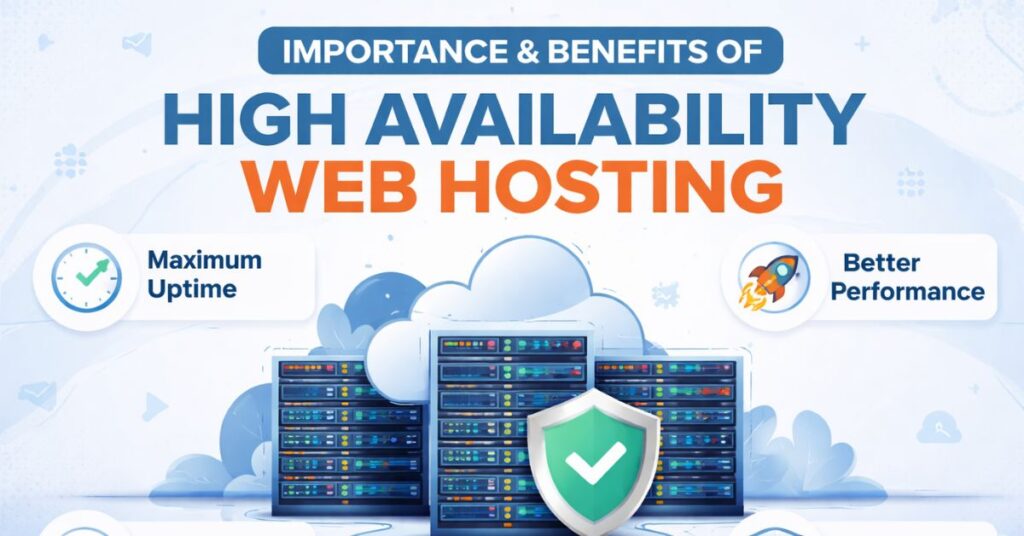
High availability web hosting is important because downtime can be very costly. Even a few minutes of downtime can result in lost customers and lower search engine rankings.
It also helps improve user experience. When your website loads fast and works smoothly, visitors are more likely to stay and take action.
For businesses, reliability is everything. High availability hosting ensures that your website remains accessible at all times.
Key Advantages List
High availability web hosting offers several strong benefits:
- Maximum uptime – Your website stays online almost all the time
- Improved performance – Traffic is distributed across servers
- Automatic failover – Backup systems activate instantly
- Scalability – Easily handle sudden traffic spikes
- Data protection – Redundant systems reduce data loss risk
- Better SEO – Uptime improves search engine rankings
- Enhanced user experience – Faster and smoother browsing
These advantages make it a great choice for businesses that depend on their websites.
Uses / Applications of High Availability Web Hosting
High availability web hosting is used in many industries where downtime is not acceptable. It ensures continuous service and smooth performance.
Businesses that rely on online platforms need this type of hosting to maintain trust and reliability.
It is especially useful for websites that receive high traffic or handle sensitive data.
Real Life Examples
Here are some real-world applications of high availability hosting:
| Industry | Use Case | Why It Matters |
| eCommerce | Online stores | Prevents revenue loss |
| Banking | Online transactions | Ensures secure access |
| Healthcare | Patient systems | Keeps critical data available |
| SaaS Platforms | Cloud software | Provides uninterrupted service |
| News Websites | Breaking news portals | Handles heavy traffic |
| Gaming | Online multiplayer | Ensures smooth gameplay |
For example, an eCommerce website running a sale cannot afford downtime. High availability hosting ensures the website remains accessible even during traffic spikes.
Future Trends of High Availability Web Hosting
High availability web hosting is evolving rapidly with new technologies. There are many advantages to cloud computing, such as ease of use and affordability.
Artificial intelligence is also improving how systems detect and fix problems. This helps reduce downtime even further.
Businesses are focusing more on user experience, and reliable hosting plays a big role in that.
Future Opportunities
In the coming years, we can expect several improvements:
AI will predict server failures before they happen. This allows systems to fix issues early.
Edge computing will reduce latency by placing servers closer to users. This improves speed and performance.
Cloud-native hosting will become more common. It offers better scalability and flexibility.
Automation will also increase. The efficiency of the process will increase as a result of this.
These trends show that high availability hosting will become even more powerful and widely used.
Why High Availability Web Hosting Matters Today
Today, people expect websites to work instantly. Slow or unavailable websites can frustrate users and damage your brand.
Search engines also prefer websites with high uptime. As a result, you’ll rank higher and be more visible.
High availability hosting helps businesses stay competitive. It ensures that users can access your website anytime without issues.
Practical Value for Users
For users, this means faster loading pages and fewer errors. It creates a smooth and reliable browsing experience.
For businesses, it leads to higher customer satisfaction and more conversions. It also reduces the risk of losing important data.
In simple terms, high availability hosting provides peace of mind. You know your website is always available when users need it.
Conclusion
High availability web hosting is a powerful solution for keeping websites online and running smoothly. It reduces downtime and improves performance.
Final Thoughts
If your website is important for your business, investing in high availability hosting is a smart move. It ensures reliability, builds trust, and helps your website grow in the long run.
It is a hosting system that uses multiple servers to keep websites online.
It uses load balancing and failover to switch between servers when needed.
It costs more than basic hosting but offers better reliability.
Businesses, online stores, and high-traffic websites should use it.
Yes, better uptime can improve search engine rankings.

Ali is an SEO specialist and technology content writer at Techsprinto, covering AI tools, SEO software, and blogging resources. He creates practical reviews and guides to help creators and marketers choose the right digital tools.