


Introduction
The demand for reliable managed service providers (MSPs) continues to grow as businesses outsource IT operations, cloud management, and security support. However, with this growth comes a sharp increase in cyber risk. That is why msp cybersecurity news has become essential reading for IT professionals, business owners, and cybersecurity teams who want to stay ahead of modern attacks. Today’s MSPs are not only responsible for their own infrastructure but also for the digital safety of multiple client environments.
Cybercriminals increasingly target MSPs because one successful breach can open doors to dozens or even hundreds of downstream businesses. From ransomware and phishing campaigns to remote monitoring and management (RMM) abuse, the threat landscape is expanding fast. MSPs must now think beyond traditional antivirus tools and adopt layered defense strategies that include zero trust, continuous monitoring, employee awareness, and vendor risk management.
This guide covers the most important developments in msp cybersecurity news, including emerging threats, industry trends, practical protection strategies, and expert recommendations. Whether you run a small MSP or manage enterprise-level client environments, this article will help you understand what is changing and how to respond effectively.
Why MSP Cybersecurity News Matters More Than Ever
Cybersecurity is no longer optional for MSPs. It is a core business requirement. When a client hires an MSP, they are not just buying technical support or cloud migration assistance. They are also trusting that provider with sensitive systems, business continuity, and confidential data. A single security failure can destroy that trust almost instantly.
Keeping up with msp cybersecurity news helps providers identify new vulnerabilities before attackers exploit them. It also gives MSPs insight into attack patterns, compliance changes, and the latest security tools entering the market. In many cases, awareness alone can prevent major incidents because teams become faster at recognizing suspicious behavior and patching weak points.
The cybersecurity environment also changes too quickly for MSPs to rely on outdated policies. New ransomware groups appear, phishing methods evolve, and supply chain attacks become more sophisticated. Staying informed allows MSPs to update their defenses in real time and protect both internal systems and customer environments more effectively.
The Biggest Cybersecurity Threats Facing MSPs Today
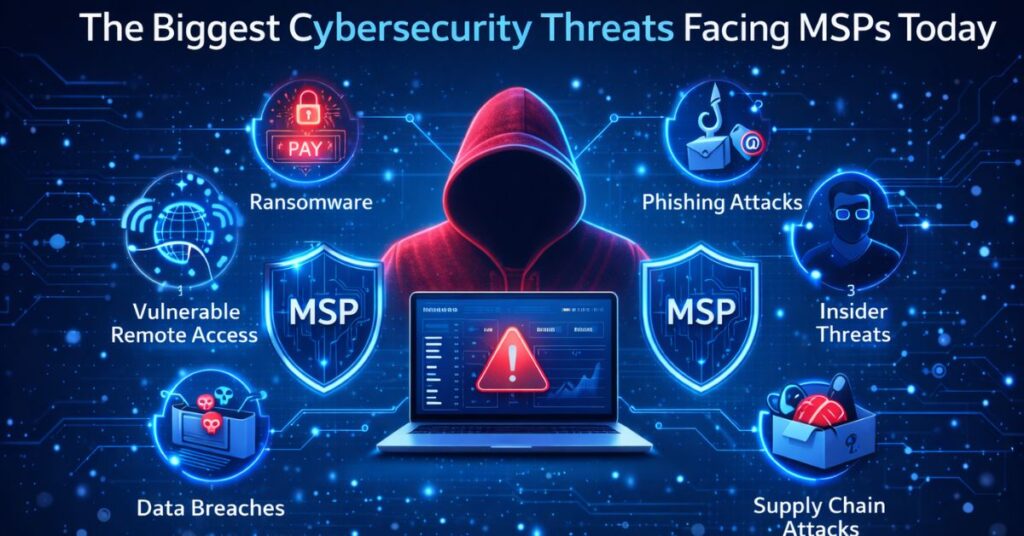
Ransomware Attacks on MSP Networks
Ransomware remains one of the most dangerous threats in the MSP sector. Attackers know that MSPs often have privileged access to multiple client endpoints, servers, and cloud platforms. This makes them highly attractive targets. If a cybercriminal compromises an MSP’s admin console or remote access tools, they may be able to deploy ransomware across many clients at once.
Modern ransomware attacks are also more aggressive than before. Many threat groups now use double extortion tactics, where they encrypt files and also steal sensitive data. If the ransom is not paid, they threaten to publish or sell that information. For MSPs, this can create a devastating mix of financial loss, reputational damage, and legal exposure.
The best defense includes strong endpoint detection, network segmentation, secure backups, least-privilege access, and aggressive patch management. MSPs that still rely on basic antivirus alone are taking a major risk.
Phishing and Business Email Compromise
Phishing remains one of the easiest ways for attackers to gain initial access. MSP employees often handle client requests, login credentials, invoices, support tickets, and cloud management tools. That makes them ideal targets for social engineering attacks.
A well-crafted phishing email can trick staff into entering credentials into fake portals or downloading malware-laced attachments. In more advanced cases, attackers use business email compromise (BEC) to impersonate executives, vendors, or clients. This can lead to financial fraud, unauthorized access, or internal account compromise.
To reduce this risk, MSPs should invest in phishing-resistant MFA, email filtering, staff training, and conditional access policies. Human awareness remains one of the strongest security layers when supported by the right technical controls.
Supply Chain and Vendor Compromise
One of the most important themes in msp cybersecurity news is the growing danger of supply chain attacks. MSPs depend on many third-party tools, including RMM platforms, PSA software, backup systems, security dashboards, and cloud integrations. If even one of these tools is compromised, the impact can spread quickly across client networks.
Supply chain risk is especially dangerous because the malicious activity often appears to come from trusted software or vendors. This makes detection harder and response slower. MSPs need stronger vendor vetting processes, regular software audits, and strict access limitations for third-party tools.
Vendor trust should never mean blind trust. Every integration should be reviewed from a security-first perspective.
Top Trends Shaping MSP Cybersecurity in 2026

Zero Trust Is Becoming the New Standard
Zero trust is no longer just a buzzword. It is becoming a practical requirement for MSP operations. The basic principle is simple: trust nothing by default and verify everything continuously. Instead of assuming that users or devices inside the network are safe, zero trust requires authentication, authorization, and validation at every step.
For MSPs, this approach is especially useful because they manage distributed users, hybrid work environments, cloud services, and remote support systems. Zero trust reduces the damage attackers can cause if they gain access to one account or one device. It also improves visibility across client environments.
Implementing zero trust often involves MFA, device health checks, role-based access, session controls, and network segmentation. While it takes planning, the long-term security benefits are substantial.
Security Services Are Becoming a Core MSP Offering
Many MSPs are evolving into MSSPs, or managed security service providers, by adding cybersecurity-focused services to their portfolio. This shift is happening because clients now expect more than general IT support. They want active protection, threat monitoring, vulnerability management, and compliance guidance.
As a result, msp cybersecurity news increasingly focuses on service expansion. Providers are launching managed detection and response (MDR), security awareness training, SIEM monitoring, dark web monitoring, and incident response planning. We cannot afford to ignore security any longer. It is becoming a central value proposition.
This trend also creates a competitive advantage. MSPs that build strong cybersecurity capabilities are often better positioned to win higher-value clients and long-term contracts.
AI-Powered Threat Detection Is Growing Fast
Artificial intelligence is transforming cybersecurity operations. MSPs are using AI and automation to detect anomalies, prioritize alerts, identify suspicious behavior, and reduce response time. This is especially useful for smaller teams that need to monitor large environments efficiently.
However, AI is also helping attackers. Cybercriminals now use AI to create more convincing phishing emails, automate reconnaissance, and improve malware evasion. This means MSPs must treat AI as both a defense tool and a threat multiplier.
The smart approach is to use AI for faster visibility while still keeping human review and decision-making in place. Automation is powerful, but blind automation can create its own risks.
Key Areas Every MSP Must Secure
Remote Monitoring and Management (RMM) Tools
RMM tools are essential for MSP operations, but they also represent a high-risk attack surface. These platforms often have privileged access across multiple devices and environments. If compromised, they can become a direct path for malware deployment or unauthorized system control.
MSPs should secure RMM tools with MFA, IP restrictions, role-based permissions, audit logging, and regular credential rotation. Unused accounts should be removed immediately, and integrations should be reviewed often.
Client Backups and Disaster Recovery
Backups are not enough unless they are secure, tested, and isolated. Many MSPs discover weaknesses only after an attack happens, which is the worst possible time. Reliable backup and disaster recovery planning is one of the most important protections an MSP can offer.
Best practices include immutable backups, offline copies, regular recovery testing, backup encryption, and documented restoration procedures. MSPs should also define recovery time objectives (RTOs) and recovery point objectives (RPOs) clearly for each client.
Identity and Access Management
Identity is the new perimeter in modern cybersecurity. Since MSPs operate across multiple cloud apps, devices, and client systems, access control must be tight and well-governed. Weak passwords, shared admin accounts, and over-permissioned users are still common problems.
Every MSP should enforce MFA, unique admin accounts, password managers, least-privilege policies, and access reviews. Privileged access should be monitored closely, and dormant accounts should be disabled without delay.
MSP Cybersecurity Priorities at a Glance
| Security Area | Why It Matters | Recommended Action |
| Ransomware Defense | Prevents business disruption and data loss | Use EDR, backups, segmentation, patching |
| Phishing Protection | Stops credential theft and email fraud | Train staff, enable MFA, use email filtering |
| Vendor Risk | Reduces supply chain exposure | Audit tools, review access, assess vendors |
| Identity Security | Protects admin and client access | Apply least privilege and conditional access |
| Backup & Recovery | Ensures fast restoration after attacks | Test backups and keep offline copies |
| Monitoring & Detection | Improves response time | Use SIEM, MDR, alerting, and logging |
Best Practices MSPs Should Follow Right Now
Build a Security-First Culture
Technology alone will not protect an MSP.A company’s culture must incorporate security. This means everyone, from leadership to helpdesk staff, should understand their role in preventing cyber incidents. Cybersecurity should not be treated as the responsibility of one technician or one security tool.
A security-first culture includes regular awareness training, incident simulations, internal reporting processes, and documented policies. Teams that are trained to spot unusual behavior often stop attacks before they spread.
Standardize Security Across All Clients
One common mistake MSPs make is allowing too much variation between client environments. While some customization is necessary, inconsistent security standards create gaps that attackers can exploit. Standardized security baselines help MSPs manage risk more effectively and respond faster when issues occur.
Examples include standard MFA policies, endpoint protection tools, patch schedules, admin controls, and backup configurations. Standardization also improves scalability and reduces technician error.
Create and Test Incident Response Plans
An MSP should never wait until an attack happens to figure out what to do. Incident response plans must be written, assigned, and tested in advance. Every team member should know how to escalate suspicious activity, isolate systems, communicate with clients, and preserve evidence.
A good incident response plan includes detection procedures, containment steps, communication workflows, recovery priorities, and post-incident reviews. Tabletop exercises can help teams identify weaknesses before a real emergency occurs.
How MSPs Can Turn Cybersecurity News Into Action
Reading msp cybersecurity news is useful, but action is what creates protection. MSPs should turn news updates into internal review cycles. If a new RMM vulnerability appears in the industry, the response should not be passive. It should trigger patch checks, access reviews, and client communication where needed.
The same applies to phishing trends, ransomware techniques, or vendor breaches. News should influence policy, tooling, and training. MSPs that act quickly gain a major advantage over those that only consume information without adapting their defenses.
A smart strategy is to hold weekly or biweekly internal cybersecurity reviews. During these sessions, teams can assess relevant threats, review recent incidents, and decide whether any security controls need updates.
Expert Tips for Staying Ahead in MSP Security
Here are some practical tips that can make a real difference:
- Enable MFA everywhere, especially on admin, cloud, and RMM accounts.
- Patch aggressively, with clear priority for internet-facing and privileged systems.
- Use security logging and alerting to catch suspicious behavior early.
- Limit admin privileges and avoid shared credentials across environments.
- Run phishing simulations to improve staff awareness and response.
- Review vendor security posture before trusting new tools or integrations.
- Document every security process so teams can act consistently under pressure.
These steps may seem basic, but they remain highly effective because many real-world breaches still happen due to preventable weaknesses.
The Future of MSP Cybersecurity
The future of MSP cybersecurity will be shaped by automation, regulation, cloud security, and identity-based protection. MSPs will need to become more proactive rather than reactive. The “fix-it-when-it-breaks” support model has lost its appeal. They want providers who can anticipate risk and reduce exposure before damage occurs.
We will also see greater pressure around compliance, cyber insurance requirements, and proof of security maturity. MSPs that cannot demonstrate clear security controls may struggle to retain larger clients. This means documentation, transparency, and measurable security outcomes will become more important.
In short, the MSP market is becoming more security-driven every year. Providers that invest early in strong security practices will be better positioned for long-term growth and trust.
Conclusion
Following msp cybersecurity news is no longer optional for managed service providers. It is a practical necessity in a threat landscape where attackers actively target MSPs for scale, access, and downstream impact. The risks are real, but so are the opportunities for providers who build strong, modern defenses.
By understanding current threats, adopting zero trust principles, securing critical tools, and standardizing client protection, MSPs can reduce risk significantly. The most successful providers will be the ones that combine awareness with action. Cybersecurity is not just about defense anymore. For MSPs, it is also about credibility, growth, and long-term client trust.
MSP cybersecurity news refers to updates, trends, incidents, and best practices related to cybersecurity for managed service providers. It includes threat alerts, ransomware developments, vendor risks, compliance updates, and security technologies affecting MSPs.
MSPs are attractive targets because they often manage multiple client systems from centralized platforms. A successful attack on one MSP can give cybercriminals access to many businesses at once, making MSPs high-value targets.
The biggest threats include ransomware, phishing, business email compromise, supply chain attacks, credential theft, and abuse of RMM tools. These threats can affect both the MSP and its clients if not controlled properly.
MSPs can improve security by enabling MFA, adopting zero trust, securing backups, standardizing client protections, training employees, monitoring vendor risk, and testing incident response plans regularly.
Yes, cybersecurity is increasingly becoming a core MSP offering. Many providers are expanding into managed security services such as MDR, SIEM monitoring, vulnerability scanning, and security awareness training.

Ali is an SEO specialist and technology content writer at Techsprinto, covering AI tools, SEO software, and blogging resources. He creates practical reviews and guides to help creators and marketers choose the right digital tools.
1 thought on “MSP Cybersecurity News: Trends and Threats”